The Apocalypse’s Apocalypse and Post-Apocalyptic Visions of Sunshine and Blessings

This posts stems from a conversation with Kyle Johnson after we watched Mad Max: Fury Road together. Thanks to Linda Quiquivix , Zoé Samudzi and William Copeland for feedback on the idea and draft to help make it vaguely coherent. In thinking about worlds I leaned heavily on Frantz Fanon’s Wretched of the Earth and Frank Wilderson’s Red, White and Black even where not cited directly. None of the above can be blamed for what follows. After completing the draft a couple of friends put me onto this great recent CBC conversation which also covers parts of what is below. Special thanks to Cass Chen who was a wonderful friend, host and conversationalist while I scribbled.

George Miller’s 2015 film Mad Max: Fury Road takes place in a post-apocalyptic Australia. Like most apocalypse/post-apocalyptic stories Fury Road comments on the present through envisioning a dystopic future. The film opens with news clips framing the violence to follow as descended from resource wars and global warming. Resource extraction and climate change are ready topics for exploring the end of the world and it is no surprise to find them as common topics for apocalyptic storytelling in cinema, novels, television and comic books. In settler colonies these stories comment upon today’s problems while neglecting that another apocalypse, one suffered by the indigenous population, pre-dates the story. Exploring post-apocalyptic storytelling with this in mind challenges settler colonial normativity and further opens up the world’s end to decolonizing visions.

Ending Othered Worlds

Fury Road, Brian K. Vaughn & Pia Guerra’s comic book Y: The Last Man and Robert Rodat’s tv series Falling Skies all offer different causes to the apocalypse. Fury Road is unspecific but points towards ecological destruction through climate change and resource wars. Y: The Last Man‘s apocalypse is an unspecified illness or curse that simultaneously kills all the mammals with a Y chromosome (in an unproduced script, Vaughn lays the blame with a U.S. biological weapons attack on China). Falling Skies‘s end of the world comes from extraterrestrial invasion.

Fury Road further comments on climate change and monopolization of resources as a means of centralizing authoritarian, patriarchal power. It follows a group of people through a mostly empty wasteland as they seek the “green place” while they are hunted by those who control the resources. Y: The Last Man narrates Agent 355 and Dr. Allison Mann as they seek to find a cause and cure for the plague that killed all terrestrial mammals with the Y chromosome but for Yorick Brown and his monkey Ampersand. The authors focus on patriarchy, Israeli militarism and market violence. While it is is a global story, it starts in the United States and most of its key plots points take place in three settler colonies, the United States, Israel and Australia, before departing to Japan and France later on. Falling Skies looks at the Second Massachusetts, an irregular militia comprised of survivors of the extraterrestrial Espheni conquest that killed 90% of Earth’s human population as they seek to overthrow Espheni rule and restore the United States. Falling Skies affirms American exceptionalism, laments how the U.S. strayed from the perceived ideals of early republic and takes a geocentric view of the universe in its firmly conservative critique of the present.

These stories offer three different critiques of the present from three different political views and are produced in three different mediums in two different settler colonies. Yet all are representative of a genre of post-apocalyptic storytelling that does not contemplate that the lost U.S. and Australian societies are premised upon settler genocides against the native populations. The closest any of the three comes and the closest the overwhelming preponderance of the genre come is when Y: The Last Man briefly discusses Israeli civil disobedience against Israeli bulldozing of Palestinian houses as part of developing the Israeli character Alter. One notable exception is Mel Gibson’s film Apocalypto which engages a pending colonial apocalypse only to justify it. Another is District 9 where some references are made yet are mediated by the white South African hero.

Settler colonialism, the establishment of the stories’ lost worlds, is an anti-native apocalypse and, in the United States, Canada, South Africa, Brazil and Rhodesia, also an anti-Black apocalypse. The racializations of Black and native are mostly different but were simultaneously constructed through the same colonizing events. Both are products of settler colonialism. Settler colonialism builds the settler’s world – the anti-Black world – by destroying the native world and does so in a 1:1 ratio. Every acre created of coastal British/American Virginia is one acre less of Powhatan Tsenacommacah. Every dunam of Israel is one less dunam of Palestine. Settler colonialism through eliminating sovereignties and populations and creating regimes of gratuitous violence brings about the end of a world. It is sometimes even named as such as when Palestinians refer to the accelerated 1947-1949 period of Zionist ethnic cleansing and the establishment of the Israeli settler state as the Nakba (‘catastrophe’).

That we settlers comprise an anti-native apocalypse means that all our cultural production is apocalyptic, is the product of an ongoing apocalypse, including post-apocalyptic visions. John Grisham’s The Firm is an apocalyptic novel of legal corruption. Miley Cyrus’ “Wrecking Ball” is an unrequited love anthem of the apocalypse. Strictly Ballroom is a film about apocalyptic cross-cultural and cross-class ballroom dancing and romance. Almost all of Danielle Steel’s opus are apocalyptic love story books. Only Miley Cyrus’ career of those four actually feels like a sign of the apocalypse but all are inherently apocalyptic as products of settler colonialism. What the intended post-apocalyptic stories Fury Road, Y: The Last Man and Falling Skies unknowingly narrate is a prior apocalypse experiencing an apocalypse itself, the apocalypse’s apocalypse. The destruction of the settler colony provides the post-apocalyptic wasteland the protagonists navigate.

Elizabeth Povinelli describes settler normativity as the “organization of sociality on the basis of the naturalness of a civilizational displacement.” Alternately put, anti-native genocide, quashing of native sovereignties and, in some settler colonies, African slavery are the fabrics that weave together and underline all settler colonial discourse and relations. Settler everyday life is the anti-native and anti-Black apocalypse but for we settlers, it is just life. In this read Furiosa and Max are settler revolutionaries fighting Immortan Joe and the settler capitalists over control of stolen Aborigine land and resources. This is why it is unsurprising that Falling Skies and Y: The Last Man both fail to engage the anti-native apocalypse despite making numerous references to the early U.S. republic, a time when even normative settler discourse knows (but always remembers to forget) that Indian Removal programs were aggressively underway in some way, shape or form.

It is hard to imagine dystopic settler stories being otherwise for settler colonialism, like all organizations of power, builds the world it inhabits. In settler colonialism’s world settler colonialism – the anti-native and anti-Black apocalypses – is near impossible to see as it is our very frame of reference. A challenging thing about normativity is it’s paradigm paradox: From what frame of reference can we observe our frame of reference? When settlers imagine the end of the world then, we imagine it as synonymous with the end of the planet or species and not the end of settler colonialism’s world. But stories consciously narrating the apocalypse’s apocalypse could describe the end of that world. They can offer a new frame of reference and play a role in subverting and disrupting settler colonial power and discourse.

The World is Ending! Hooray!

Settler storytellers explore all kinds of fascinating, entertaining and illuminating scenarios to describe the end of the world. The Terminator and The Matrix stories look to the artificial intelligence singularity. Deep Impact ends part of the world with a comet collision. The Walking Dead comic book, tv series and a long-running series of George Romero’s of the Dead films narrate a zombie apocalypse. The Wayward Pines book trilogy and tv series look at apocalypse through divergent evolution and On the Beach‘s apocalypse happens through nuclear war. None of the above reflect on the anti-native and anti-Black apocalypses.

Potentially even non-anthropocentric ones can be told. For example there is Vitamin Z – a yet to be made film documenting the multiyear boon in slow-moving, uncoordinated, easily obtainable, though quite bitey, prey for carnivores and scavengers that follows the zombie apocalypse and restores their populations to pre-capitalist/pre-colonial population levels. I hope Keith David or David Attenborough is available to narrate!

But what about when the end of the world is the apocalypse’s apocalypse? Frank Wilderson notes that, “The Slave needs freedom from the Human race, freedom from the world. The Slave requires gratuitous freedom.” Indeed, settler colonialism’s world of dispossession and gratuitous violence not only can end, but should. Stories of the end of this particular world need not be burnt skies and genocide. In narrating the end of an apocalypse they may well tell the opposite: clean air, vitality and an end to gratuitous violence and suffering. The end of settler colonialism’s world can be sunshine and blessings, little children laughing and singing silly songs, lovers dancing or any other beautiful thing. These are legit post-apocalyptic visions when describing an apocalypse happening to a prior apocalypse when combined with Black and native liberation. So are ones less polarly optimistic or romantic.

The material world stories of the whole or partial end of settler rule in Zimbabwe, Liberia and South Africa are decidedly complicated and frequently tragic. Settler colonialism is not the only wronging world in play as Black feminism’s intersectional resistance teaches. Yet stories consciously telling the apocalypse’s apocalypse can offer a discursive break, a frame of reference separate from settler colonialism’s dispossession and gratuitous violence. As Frantz Fanon wrote, “To break up the colonial world does not mean that after the frontiers have been abolished lines of communication will be set up between the two [colonial and decolonized] zones. The destruction of the colonial world is no more and no less than the abolition of one zone, its burial in the depths of the earth.” Stories telling the end of this world can be part of the shovel.

None of this is to argue that post-apocalyptic and apocalyptic stories cannot be robot apocalypses, nuclear holocausts or extraterrestrial invasions. They are frequently insightful, critical, imaginative and even beautiful. But such visions can still adopt a frame of reference not dependent upon settler colonialism’s dispossession and gratuitous violence and recognize that the anti-native and anti-Black apocalypses have long been happening. In doing so stories of the apocalypse’s apocalypse can obliterate a world that has it coming.

A few words on Marek Edelman

An obituary from a few years back for Marek Edelman just came across the timeline on the book of faces. Edelman remains an inspiration for reasons political, moral and symbolic. He is most known as a leader in the Warsaw Ghetto uprising against the Nazis but from early years was a Bundist and fought for Jewish liberation as part of universal liberation. He did not fight for assimilation but specifically as a Jew for universal liberation. The Bund is one of several salient examples that show particularist and and universalist struggles are not polar, but can easily be intertwined.

Edelman continued his revolutionary activism through out his life including sending a statement in August, 2002 addressed to “commanders of the Palestinian military, paramilitary and partisan operations – to all the soldiers of the Palestinian fighting organisations”. The statement has big problems but also tremendous power in where he addresses Palestinian armed groups as peers and also positions them as ‘partisans’, a term carrying considerable weight coming from a legendary anti-Nazi partisan resistance fighter. Thus it infuriated Zionists coming as it did during a hot summer of the Second Intifada.

One thing he said elsewhere has always struck me and stuck with me.

“We knew perfectly well that we had no chance of winning. We fought simply not to allow the Germans alone to pick the time and place of our deaths. We knew we were going to die. Just like all the others who were sent to Treblinka…. Their death was far more heroic. We didn’t know when we would take a bullet. They had to deal with certain death, stripped naked in a gas chamber or standing at the edge of a mass grave waiting for a bullet in the back of the head…. It was easier to die fighting than in a gas chamber.”

In this phrasing he captures all kinds of dignity amongst the shoah‘s horror. Paulo Freire wrote in Pedagogy of Freedom that “unfinishedness” is a defining human characteristic. Edelman affirms this when he says, “We fought simply not to allow the Germans alone to pick the time and place of our deaths”. May he rest in power and long may we lift his name.

The Anti-Black Geography of Revitalizing Detroit

The following essay leans heavily on—though cannot be blamed on—the works of Saidiya Hartman, Jared Sexton and Frank Wilderson despite me citing only one directly. Thanks to Kristian Davis Bailey and Lester Spence for critical feedback towards making this screed coherent.

It seems that every day brings a new story about Detroit’s “revitalization”. The Huffington Post, New York Times, Washington Post, NGOs and others point to new construction, new restaurants opening, the rehabbing or demolishing of old buildings, foundation and capitalist investment in the city and gentrification as starting a new chapter in Detroit’s history. Mayor Mike Duggan even has a “Housing and Revitalization Department” and Wayne State University hosts “Detroit Revitalization Fellows”. The narrative goes something like: “Until recently Detroit was an urban wasteland left destitute by deindustrialization, corrupt and incompetent governance, neglect and white flight but all that is changing. A new Detroit is being built and you can be a part of it!” Both this narrative and the processes it describes contain a fundamental anti-blackness. They are premised on interrelated white capitalist accumulation, the commodification and erasure of Detroit’s black geography, and black social death.

The Revitalization of Detroit

A major part of ‘revitalizing Detroit’ is creating spaces for white fantasy. This is commonly done through describing the existing, living black geography as a “blank canvas” for white gentrifiers, capitalists, politicians and academics to make of what they may. Leading gentrification figure and author Toby Barlow wrote in the New York Times in 2009 that “Detroit right now is just this vast, enormous canvas where anything imaginable can be accomplished.” Dan Gilbert, Lebron James’s boss and owner of predatory lending firm Quicken Loans, is lauded as a champion of revitalization for moving Quicken’s headquarters to downtown Detroit and bringing so many newcomers to the city to work for him. Gilbert both markets subprime mortgages then chairs the “Blight Task Force” that demolishes empty houses, many of which are foreclosures caused by his firm. He can both blight and fight blight. Gilbert maintains a detailed model of downtown Detroit which only lights up buildings after he purchases them which more or less embodies this entire essay. His actions with the Blight Task Force mostly take place in Detroit’s low-income neighborhoods but he also played a role in the 2013 mass eviction of working class black seniors and disabled people from the Griswold building downtown. With the removal of black tenants perhaps Gilbert can now light up the Griswold building on his model. It has been ‘revitalized’.

Gilbert, the Ilitch family, and other billionaires are leading the charge but white petty capitalists and merchants are also joining in. Numerous on Crain’s Detroit’s annual “20 in their 20s” lists view Detroit as a “blank canvas”. Some new arrivals found small capitalist enterprises like the Parker Street Market that replicate what black Detroit social movements have been doing, except reimagined for accumulation purposes rather than community prosperity. Typical to how white supremacy inverts relations, community prosperity is often imagined as white accumulation through ‘socially conscious’ capitalist enterprise. The Parker Street Market is emblematic of the small scale ‘entrepreneurs’ exploring fantasies in Detroit they could not realize at such relatively low expense in wealthier, whiter geographies. Enterprises like the much ballyhooed Whole Foods Detroit do like Parker Street but on a vastly larger scale. The black social movements are scarcely noted, often erased entirely, while white capitalists are toasted. To the degree that black Detroiters are acknowledged it is as Jon Moy wrote about Shinola. Shinola is an extraordinarily expensive retail and assembly shop located in the Cass Corridor, a neighborhood now marketed as ‘Midtown’, and is itself part of turning the Cass Corridor into Midtown. Moy writes, “Shinola and other entrepreneurs market themselves as white knights, swooping in to save the noble savages.” Here one’s politics might be positioned by whether one can tell any difference between shit and Shinola.

When former Governor Jennifer Granholm convened a panel to restructure Detroit schools she asked them to treat schooling children in a district around 90% black like a “blank canvas”. Detroit’s schools were at the time, as they continue to be, under Emergency Manager (EM) rule, run by a technocrat with extraordinary powers appointed by the governor. EMs replace the decision making power normally allocated to elected officials (leaving the actual power of U.S. elections for another time). Democrat and Republican governors appoint Emergency Managers (EMs) to run the schools and city no matter decisions made by Detroit’s black electorate (as they’ve done with most majority-black cities and towns in Michigan). Black people make up around fourteen percent of Michigan’s populace and nearly half have been subjected to Emergency Manager rule, compared to less than one percent of white Michiganders. Detroit’s schools or city government have been under EM rule for over fifteen years now. The decisions of black Detroiters simply do not matter and are erased. Emergency Management is a more politically palatable action than the phrasing used in 2004 by a white suburban politician describing a need to “suppress the Detroit vote.” Detroit politics are a “blank canvas” for the state’s white political leadership to inscribe their Emergency Management experiment upon. The ‘blank canvas’ term is now less in use than in past years due to push back from Detroiters continually emphasizing that they actually exist but the concept persists largely unperturbed.

Detroit’s black geography is fungible to outside real estate speculators, a new petty landlord class (a place where there is a significant measure of black capitalist participation), the fantasists and the property hoarders like John Hantz, Gilbert and others. They buy up houses, buildings and plots in any low-cost neighborhood. They know nothing of the neighborhoods because black neighborhoods do not matter to them apart from a vision of capital accumulation. The speculators seek a quick turnaround anywhere and future profits around the current periphery of gentrification. The landlords seek higher rents (more easily accomplished with white renters who receive higher wages). The hipster fantasists do their entrepreneuring (gag!) while bringing a higher police presencethey want Detroit grime but not Detroit crime. The hoarders seek to create an artificial scarcity so as to drive up all prices. Detroit’s black geography is fungible to white capitalist accumulation and it is explicitly the city’s blackness that makes it so.

By an overwhelming margin black Detroiters bear the brunt of these and related oppressive actions. The population embodies the Detroit purportedly in need of vitalizing, of adding life to, for anti-blackness dictates that black people are socially dead. It is mostly black people who are being foreclosed upon and evicted, who are having their votes invalidated by EMs, who are having their water shut-off and then their kids removed due to no water service, whose neighborhoods become playgrounds for real estate speculators. But black suffering as a negative is a rare topic of discussion in such matters and condemnation of these actions outside of Detroit too is rare. For how can the socially dead suffer? Indeed in most conversations it is the black working class and the, in Frantz Fanon and Huey Newton’s positive understanding, black lumpenproletariat who are said to be responsible for the consequences of white supremacist capitalist policies rather than racial capitalism being the cause. Inside racial capitalism it can hardly be otherwise. It is official policy so it is as Saidiya Hartman said, “No crime can occur because the slave statutes recognize no such crime.” There is no more telling example of Hartman’s phrasing than the 2010 collaborative reality television and police murder of Aiyana Stanley Jones on Detroit’s East Side. She was a young girl sleeping in her bed when police and a reality tv crew burst through her door and killed her while exercising a warrant. There has been no accountability and the cop that murdered her is back at work disciplining black bodies for the state.

The Devitalization of Detroit

Large scale disinvestment and the underdeveloping of Detroit began in the 1960s after highway construction helped facilitate white flight to the suburbs. Highways constructed for the imperial war effort in the 1940s paved the way for white relocation to suburbs ever further north across 8 Mile road and to the city’s west. The population shift was triggered by accumulation from industrial production during the war, the automobile industry and the arrival of vast numbers of black migrants from the South. In the case of the construction of the Chrysler Freeway (I-75 and I-375), this was accomplished by paving over the remains of Black Bottom and Paradise Valley, neighborhoods comprising the cultural, political and economic core of black Detroit demolished by Mayor Cobo. Alternately put, white flight was in part realized in driving over an intentionally dislocated and disoriented black civil society and geography. The erasure described above is not new. It was tried through physical demolition as with Black Bottom and with real estate redlining from the moment Detroit’s black population began rapidly expanding.

Industrialists, CEOs and boards of directors closed and relocated manufacturing plants away from the increasingly black city. Others used automated production not to enhance the workforce but instead to deskill (so as to pay lower wages and reduce bargaining power) and replace (so as to pay no wages and face no bargaining power) workers. Many did both. With the removal of jobs came the removal of the sector serving those employees and employing others. The managerial and most of the white working class followed those jobs and fled the rapidly arriving black population that, for a few decades, continued to grow. Whites increased their flight in response to the 1967 Rebellion, commonly called ‘the riots’. In the late 1980s the black population started to leave too, this not counting the disappeared tens of thousands continually sent off to prisons all over the state. Meanwhile successive neoliberal local and state administrations have sold off and given away control of city assets, most recently Belle Isle.

The ‘revitalization’ narratives note some of the above but do so with minimal critique of the racist, capitalist policies that made it this way. Detroit’s problems didn’t simply happen, they were and are being engineered and are the predictable results of both corporate and government policies (to the degree that it is useful to separate them). Further, they note these problems but ignore positive action by black residents and every solution not offered by the elite. This is due to another aspect of anti-blackness, the social death of slavery.

Rather than being a blank canvas the actually existing Detroit is a canvas painted over and again, beginning with French and later British settlers killing and expelling the local Ojibwe population and establishing a slaveholding settler colony. How is today’s Detroit, a near inverse of the original settler colony, with its block parties, vibrant social movements, mosques, churches, restaurants, clubs, numerous annual festivals, its own dances, musics and other cultural production in need of revitalization? Of needing an injection of life? Because it is Black metropolis. As Hartman, Orlando Patterson, Frank Wilderson and others have illustrated, blackness to white America is social death, is a marker of a fungible commodity rather than humanity. For white America adding ‘matter’ to ‘black lives’ is almost redundant as it disavows black life in the first place.

Black life in Detroit is unrecognizable to the planners of the New Detroit. Detroit the existing, living city simply isn’t to the elite, so long as it is a black city. Revitalization is the influx of young white people and investments by white capitalists. Devitalization—a geography of social death and an unuttered word—is the process by which Detroit became a black metropolis. Detroit is said to be in need of revitalization and that revitalization imagines a geography devoid of humans, a “blank canvas”, because the social death of blackness imagines black residents not as individual people but as fungible markers of accumulation. These narratives show a total and aggressive contempt for the black metropolis, its people and social movements. But “revitalization” is not treated as problematic no matter the massive harm it’s causing because, to repeat Hartman’s phrasing, “No crime can occur because the slave statutes recognize no such crime.”

Mr. Monk and the Toxic Masculinity

This essay is dedicated to the wonderful Alla Palagina who generously shared countless episodes of Monk with me and with whom I initially discussed this episode after we watched it in early 2011. May she rest in power.

Adrian Monk could represent an alternative masculinity. His clumsy, fumbling, mumbling, constantly terrified competence as police detective stands in stark contrast to the chest-puffing, misogynist, homophobic normative masculinity that pervades popular culture. Instead of embracing his competence though, Monk constantly aspires to normative masculinity. A telling episode is 2006’s “Mr. Monk and the Astronaut”.

Wagner prepares to murder Raphelson

Wagner prepares to murder Raphelson

“Mr. Monk and the Astronaut” begins with famous astronaut and test pilot Steve Wagner (Jeffrey Donovan) drugging Joanne Raphelson (Brianna Brown), a former Vegas showgirl he once dated and whom he severely beat and hospitalized several years earlier. Raphelson planned to reveal the beating in a tell all biography.

Wagner is a confident, charismatic white alpha male predator. And he has an airtight alibi for Joanne’s murder having been in planetary orbit at the time of Joanne’s death. He charms the police, Monk’s personal assistant Natalie and the children in Natalie’s daughter’s class when both he and Monk go to present on career day. Monk is the only one who believes he killed Joanne.

Children mock Monk at the career day then proceed to terrorize him with laser pointers. Hijinks ensue and afterwards he confronts Wagner in the hallway. Wagner uses aggressive physicality to cower Monk then tells him, “You’re a flincher, you’ll never stop me. Because when the chips are down when it really counts, you are always going to flinch.” This, combined with Monk’s panic about the laser pointers sets up the episode’s final confrontation.

Wagner makes Monk flinch

Wagner makes Monk flinch

Wagner ridicules, questions and challenges Monk’s masculinity throughout the episode. Monk confesses to his psychologist, “When I look at a manly man like Steve Wagner, I just feel weak. I just feel so inadequate. I know he’s guilty, but I’ll never be able to prove it.” Here Monk affirms Wagner’s perceptions as well as Wagner’s masculinity. This violent misogynist represents the manhood to which Monk aspires.

Monk is steadfast in the face of laser scopes

Monk is steadfast in the face of laser scopes

The films concludes with Monk confronting his fear and placing his body in front of a jet Wagner is piloting to prevent its takeoff. Monk remains steadfast in front of the plane even when soldiers arrive with (for some reason) laser scope rifles which cover him much like the earlier laser pointers. Wagner is taken into custody from the plane. As he is being handcuffed Wagner makes eye contact with Monk and gives him an acknowledging nod, validating his manhood. Alternately put, the episode resolves with Monk receiving validation of his own manhood through the toxic masculinity of the “manly man” he succeeded in incarcerating.

Murderer of women gives Monk a nod of approval

Murderer of women gives Monk a nod of approval

Monk is not exceptional in embracing toxic masculinity to validate the manhood of its male characters. The episode in question does not invent it but is does represent yet another exchange in and (re)production of normative patriarchal discourse.

“Mr. Monk and the Astronaut” (season 4, episode 14) originally aired on 3 March 2006 to around 5.65 million households in its initial airing.

The Interview – Two Deeply Unpleasant Hours of Cinema Paradisbro

The Interview

dir. Evan Goldberg & Seth Rogen
112 min | 2014
Columbia Pictures, L Star Capital, Point Grey Pictures

the-interview-poster1

Evan Goldberg and Seth Rogen’s latest film The Interview was bound to get some attention even before its distributor, Sony, was hacked and the ensuing debacle with alleged threats from North Korea (DPRK). A film this racist would get attention regardless. Unfortunately due to the publicity around the Sony hack many more people will likely be subjected to The Interview and the attention won’t be as negative as it deserves. What follows includes spoilers if you believe something already rotten can be spoiled.

The Interview opens with an othering scene of a young North Korean girl singing about destroying the U.S. before an audience of dignitaries prior to a missile launch. The othering completes with a series of shorts news clips about North Korean ruler Kim Jong-un (Randall Park) being the next Hitler before introducing Dave Skylark (James Franco).

We meet Skylark as a tabloid news host interviewing Eminem in a scene that kicks off nearly incessant gay jokes. Skylark is the kind of guy with no qualms about breaking into caricatured Black Vernacular English as ‘comedy’ nor any idea about why anyone would have such qualms. Pressured by producer Aaron Rapaport (co-director Seth Rogen) to due serious journalism, Skylark comes up with the idea of interviewing Kim Jong-un as a bridge. Rapaport will get serious news and Skylark will get sensational ratings.

Rapaport is the sober foil to Skylark’s unfiltered and hyper stream of consciousness. He’s shamed for his tabloid work by a fellow journalism school grad who now works for 60 Minutes. Rapaport’s sophistication is juxtaposed next to Skylark’s visceral racism and sexism. But they both due caricatured Korean accents. They both immediately ogle Agent Lacey’s (Lizzy Caplan) breasts. They both constantly make gay jokes. While Skylark is the dense one, the juxtaposition between he and Rapaport is one of tone only. So when at the end when Skylark says to a puppy, “Guess who’s going home to America where they don’t eat doggies” and Rapaport doesn’t let him finish he is not disapproving, merely hurrying him along.

Sook (Diane Bang) and the North Koreans are introduced with a soundtrack is only slightly less ominous than Darth Vader’s “Imperial March” in Star Wars, just in case they weren’t sufficiently othered earlier. When we meet Sook she is immediately objectified in the familiar way of cinema, with a cut pan up her body. The body pan opens up women’s bodies to the male gaze and orients, or given the aggressive and regressive Dragon Lady stereotyping in this case orientalizes, viewers to objects instead of characters.

Lacey then recruits Rapaport and Skylark in a plot to assassinate Kim. Skylark is convinced to go along with the plan by Lacey’s breasts, bangs and glasses (which are as close as The Interview gets to Lacey’s character development). Any justifications are secondary to Skylark’s pursuit of sex. The rationalizations eventually put forward are concentration camps, a hungry population, a nuclear threat and totalitarianism. These are never explored nor are their reflections in the United States but for Kim quickly stumping Skylark near the film’s climax with a retort about the U.S.’s mass incarceration regime.

The only character with any depth is Park’s Kim. He is a vulnerable tyrant with daddy issues and the initial portrayal is only half-bad. But as the film goes along any charisma or depth gets strained out of the narrative. As the final confrontation kicks off and assassinating Kim gets underway the film moves from boring to boring and bloody with the othered North Koreans being mowed down à la Rambo and similar Cold War tripe about evil Asians. The White Hero Skylark rousing North Koreans to rise against Kim is as ridiculous as the Russians chanting “Rocky! Rocky!” at the end of Rocky IV. Indeed Reagan-era Hollywood is where The Interview’s heart is. It aspires to be a Cold War buddy comedy and even offers the Scorpians’ “Wind of Change” as the credits roll.

Rogen and Goldberg’s idea of humor is something like “wacky” combined with racism, gay jokes and an obsession with anuses and inserting things into them. They do not contact a DPRK embassy to set up the interview, instead a wacky path including the Olympic Committee and a Rapaport trip to China ensues. There is a wacky drone strike that kills a tiger. Rapaport is wackily racist to the DPRK official on the phone. Ad infinitum.

The Interview has virtually no character development but plenty of overacting. It has a few quick montages – some with short clips some with jump cuts – that serve no purpose. It is aggressively sexist, homophobic and racist. The Interview is a comedy without any. I did chuckle once during a fight scene near the end of the movie. Rapaport is fighting a television worker who bites off one of his fingers. Then Rapaport bites off one of the other guy’s fingers. Then the guy bites off another of Rapaport’s fingers. That third one was a little funny.

Despite all of this The Interview has already found an audience. In addition to Seth Rogen’s dedicated following of people who think “Because I Got High” was robbed at the Grammys, U.S. nationalists are also up in arms about Sony’s pause on distribution. The nationalists are presenting The Interview as something to do with free artistic expression or fighting oppression. Not incidentally, neither of these audiences is up in arms about the multitude of racist emails released by the hackers nor about how vigilantes or cops kill Black women and men every twenty-eight hours. It has nothing to do with free artistic expression. Free expression does not mean an obligated audience and The Interview has not earned one.

Not distributing The Interview was both ethically and artistically the right decision but Sony has gone ahead with it anyway. Don’t see it. For the $6 Sony is charging to stream it you can find better ways to spend two deeply unpleasant hours. You could buy two bottles of soy sauce and drink them slowly. You could buy a roll of industrial tape and use it to remove body hair. You could buy a gallon of bland ice cream and see how long you can sustain brain freeze. All of these are better than watching The Interview.

A Punch Line. A White Supremacist Contortion.

This article examines U.S. public awareness of mass incarceration of Black people through the stories told on police procedural television programs. Though not quoting directly when focusing on mass incarceration and White supremacy I am informed by lectures and writings on prisons and racism by Angela Davis, George Jackson and Mariame Kaba. Please see their works for in depth analysis of prisons and White supremacy and Kaba’s Project NIA (or related efforts across the continent) for ways to take action to end the injustice described in this essay.

The punch line is a common exercise in storytelling beyond comedy. Punch lines are occasionally educational but much more often they depend on what the audience already knows. For this reason they are at least as telling of the audience as they are of the storyteller. This essay examines a particular punch line common to cop shows, with a focus on a 1987 episode of Hunter, that of the comeuppance of neo-Nazis by the police when the neo-Nazis are to be incarcerated in the U.S. prison system and thus, alongside people of color. Further, this essay also looks at what this punch line says about public awareness of and support for the mass incarceration of Black people and how normative White supremacist discourse contorts it into a purported anti-racism.

Bad tv

Bad tv

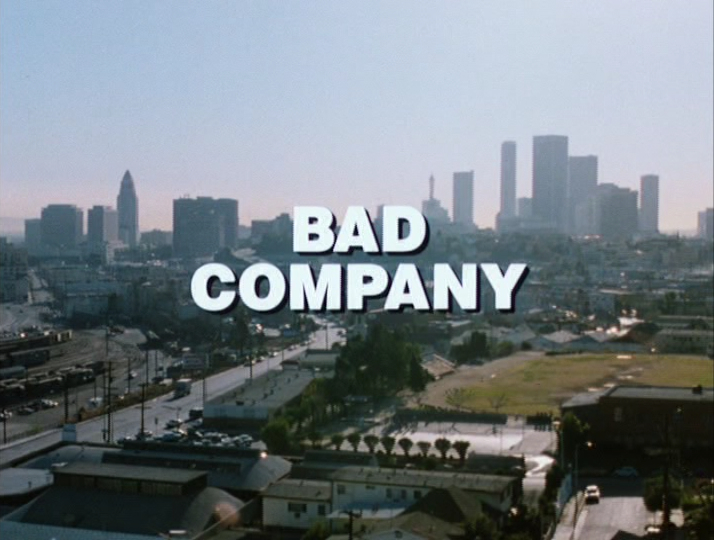
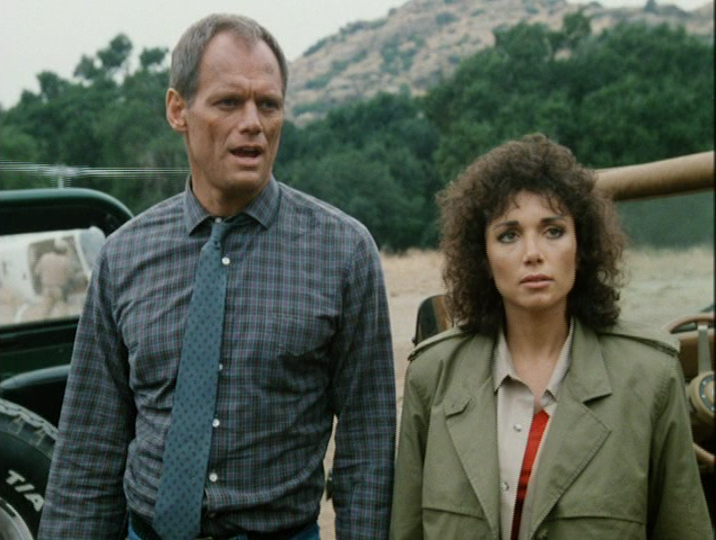
The Hunter episode “Bad Company” (Season 3, Episode 11 – 10 January 1987) begins with a group of white men and women robbing a Los Angeles gun store and killing the store owner. Police arrive in short order and a shoot-out between the cops and robbers ensues. Two of the robbers are injured, one killed and the other slightly wounded. The wounded party is Angela (Lar Park-Lincoln) who is transferred into the custody of Detective Sergeants McCall (Stepfanie Kramer) and Hunter (Fred Dryer) upon release from the hospital. We soon find out Angela is the daughter of Brother Hobarts (Dean Stockwell), the head of the National Aryan Order, a White nationalist militia on the outskirts of Los Angeles.

Hunter and McCall transport Angela to another location. En route they engage her on her ideology, telling her she is off base as they attempt to turn her snitch. She replies, accurately but against normative liberal White supremacist discourse, that White nationalism is “what America is all about.” She continues while elucidating a fairly mainstream – if a little cartoonish so as to indicate viewers shouldn’t identify with with Angela too strongly – racist narrative “The right of decent Americans to defend their way of life against freeloaders and subversives and the mud races. I mean it’s nothing personal guys, but you’re on the wrong side.”

Villians all

Angela explains to McCall and Hunter why her version of White supremacy is better than theirs.


Hunter and McCall are captured by the National Aryan Order during the trip when the group rescues Angela from police custody. Up to this point Angela is still loyal to the Aryan National Order. McCall and Hunter do not manage to recruit her until one group member murders her love interest (who is also a neo-Nazi). Now betrayed, albeit not ideologically, Angela helps the cops escape and the group is eventually joined by other police who proceed to stop Brother Hobarts and crew from carrying out a planned attack. Hunter confronts Brother Hobarts, who is by this time in bracelets, and delivers the punchline “you Brother Hobarts are going to prison. Half the men you meet there belong to those mud races you were talking about. They’re gonna like you.”

Fuck the police

Hunter gives Brother Hobarts his comeuppance by using racism to fight racism. Wait, what?

This is a somewhat common punch line in cop shows. The Law & Order episode “Prejudice” (Season 12, Episode 10 – 12 December 2001) ends with the incarceration of a racist white man. As the prosecutors prepare leave the office at the episode’s end, District Attorney Nora Lewin (Diane West) says, “Wonder if Burroughs will still have a problem with minorities when he gets to prison and finds out he is one.” In the CSI episode “World’s End” (Season 10, Episode 19 – 22 April 2010), Nick Stokes (George Eads) says to a white supremacist suspect he is interrogating, “But you know what, I’m gonna do you a favor, since you like to whoop so much ass. I’m gonna have the warden put you in with some African-Americans, so they can give you an up close and person lesson on race relations.” There are several other examples.

The Racial Caste System As Anti-Racism

These punch lines mean to show the police and the mass incarceration of Black and other people of color as possible tools against racism rather than as baselines of systemic White supremacy. These punch lines are only given meaning by an audience who will understand them as the comeuppance of racists rather than as an affirmation of the racist order of things. For this to work without souring an audience that largely believes it isn’t racist or, at least, not about prisons and crime, Black criminality must be understood to as a matter of fact rather than as a matter of racial caste formation or, in other words, Black folk must be understood as criminals rather than mass incarceration being understood as the criminalization of Black people. Were it the other way around the shows would be (probably) canceled as the audience would (probably) receive the punch line as cruel cynicism rather than anti-racist comeuppance. (I use probably in parentheses because with White supremacy you can never be too sure that something horrifying actually will be taken as going too far even when problematized.)

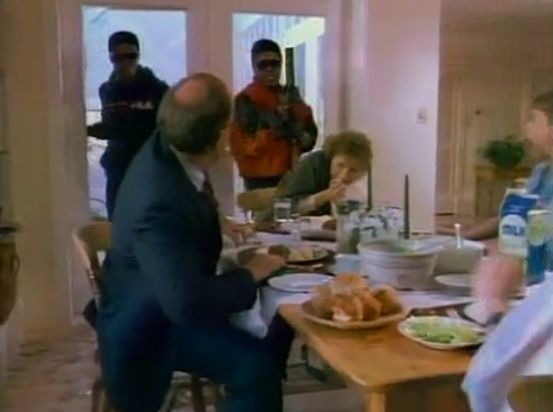
For example the pilot episode of 21 Jump Street aired four months after the Hunter episode discussed above. It’s opening scene features a wealthy white family of four seated around the dining room table for a meal when two young Black men with shotguns break through the glass of the patio doors and lay siege to the family. This introductory scene of one of the most successful cops shows is anchored with Black criminality. The 21 Jump Street pilot offered nothing novel but affirmed what was already common knowledge; that Black people were dangerous criminals, the conclusion of which is that the prisons must be full of such criminals.

21 Jump Street kickstarts its franchise with Black criminality

21 Jump Street kickstarts its franchise with Black criminality

The crudest neo-Nazi articulations fall far enough outside of White supremacist normativity for the mainstream public, especially though not quite exclusively the mainstream white public, to reject them. So long as mass incarceration of Black and other people of color is not understood as a racial caste system the public receives punch lines like those above as Black criminality being just desserts for neo-Nazis who get locked up.

An Inversion Version

What this essay describes is one example of White supremacy’s incredible discursive flexibility. The Hunter, Law & Order and CSI episodes described above contribute to normative discourse a perfect inversion of the racial caste system. Mass incarceration of people of color is a baseline of White supremacy. Yet the punch line to these stories is one where said systemic baseline is re-imagined as an anti-racist tool against individual white supremacists while the enforcers of the baseline (the police and prosecutors) relish in their enlightened anti-racism to a produce a feel good moment for the audience. The contortion is horrifyingly impressive.

These punch lines demonstrate another thing. This essay focused on the Hunter episode for a reason; it aired in 1987. United States liberals – largely unfamiliar with the radical Black tradition that produced critical prison analysis decades ago – are ‘discovering’ mass incarceration as a phenomenon of a racial caste system since the 2010 publication of Michelle Alexander’s tome The New Jim Crow. But the Hunter audience over two decades before that book had to understand that the United States fills its jails in a wildly disproportionate manner with Black folks, otherwise the punch line doesn’t work.

Point being, White America knows and been knowing, it’s just not considered a problem. Mass consciousness is not critical consciousness when embedded in normative oppression. That the broad contours of an oppressive system are common knowledge might, however, offer opportunities for organizing. The same knowledge in a framework rejecting Black criminality, mass incarceration and White supremacy produces a very different discourse. To assist with efforts to produce a liberatory discourse please visit the “Resources” page on the Project NIA website.

Review: A Land Without People

A People Without A Land (2014)

78 min

Dir. Eliyahu Ungar-Sargon

http://www.withoutaland.com

A shorter version of this review was originally solicited by a better website but what I wrote was shit. Luckily my own website here has no standards at all and an audience of around four unlucky browsers who just saw Star Wars for the first time and couldn’t remember C-3PO’s name to accurately google the droid and thus are subjected to the following ramblings. What follows is based on the original review but takes some aspects of the film as points of departure to discuss topics in but not unique to A People Without Land.

APWAL Title

Eliyahu Ungar-Sargon’s latest film, A People Without A Land, provides another entry into cases made for Palestinian liberation as a one-state solution. Ungar-Sargon describes himself as a “Jewish Rebel” on his website. Indeed in previous documentaries Ungar-Sargon has examined male circumcision and Jewish fetishization of the Shoah from, if you’ll forgive the bad pun, ultra-unorthodox angles. In A People Without A Land he compiles interviews with progressive Palestinian activists, Israeli liberal Zionists, radical right- and left-wing Israelis, stock footage, music and journalistic footage to present his case.

The film largely follows hegemonic liberal discourse from early Zionism through the Oslo years towards a two-state solution in the first third, starts the story over with a historical track towards a one state solution in the second third, then prosthyletizes liberal nationalism for the remainder. The film starts with with Zionism’s generative context in 19th century Central and Eastern Europe and initially follows Zionist settlement in Palestine through the Nakba (1947-49 war in Palestine), Naksa (Six Day War) and into the Oslo Process years through the second intifada and Operation Cast Lead. It narrates Zionist settlement, the mass expulsion of Palestinians from 1947-49, the conquest of the remainder of Palestine in 1967 and Israeli settlement and oppression of Palestinians in the West Bank, Jerusalem and Gaza Strip through the present. A People Without A Land concludes making a case for a one-state solution in Palestine. Through all this the film shoots through a critical, to one degree or another, lens.

A significant strength when compared to most Palestine documentaries is the narrative space allotted to refugees and the Right of Return, a topic frequently ignored or given only lip service despite most Palestinians being refugees. As important is how Ungar-Sargon engages refugeedom no matter where the refugees are located, including those who are citizens of Israel, a refugee population close to discursively erased in all liberal and most non-Palestinian radical discourse. A People Without A Land even briefly explores Right of Return’s more practical aspects in a late sequence where it documents activists and architects from Miska Committee, Decolonizing Architecture and Zochrot discussing the reestablishment of Miska, a Palestinian village depopulated during the 1947-49 ethnic cleansing of Palestine. In fact this is basic to the film in that it is bookended with scenes from Lifta, another depopulated Palestinian village. Other strengths include a skeptical eye towards the Peace Process and Palestinian Authority (the latter topic part partially subverted by having Saeb Erekat as a protagonist).

Except…

Yet the film leaves much to be desired narratively, historically and conceptually. The filmmaking is unremarkable but for Ungar-Sargon’s poor decision to include over thirty subjects in a film just seventy-eight minutes long. This works out to a new character every two and a half minutes or so. These characters range from far Right-wing Israelis to left-wing Palestinian advocates for decolonization. Ungar-Sargon offers nothing to bridge either the widely divergent political viewpoints nor the far too numerous subjects making the film frequently incoherent. It’s like someone’s “Israel-Palestine” youtube playlist.

For example, in one segment West Bank settler Ari Abramson says, “Most Palestinians do not recognize Israel’s right to exist.” Ungar-Sargon then refutes with Bethlehem resident Samer Kokaly — who supports one state — saying that Israel has a kind of right to exist. The film unambiguously supports a one-state solution so what’s the point of this segment? Leaving aside that there is no such thing as a “right” to settler rule in Palestine, it is out of place in a film explicitly rejecting Israel’s premise. There is a possible logic behind this scene to which I’ll return below.

In it’s final third the film variously advocates for and against a one-state solution. That Ungar-Sargon’s film advocates for a one-state solution is only clear because he very explicitly says so at the very end. Key interviewees Gershom Gorenberg and Gershon Baskin state their objection to one state in terms, too much hatred and all that familiar tripe, not so different from that offered by Right-wing Israeli geographer Arnon Soffer (Why is he interviewed at all? And why would the filmmakers celebrate his attendance at a screening?!) or, for that matter, George Wallace in his day. Both Gorenberg and Baskin are earlier posited as critics of Israeli repression of Palestinians so their advocacy for settler rule is still posited as some type of solidarity, not the crude racism it is.

A People Without a Land also includes historical misconceptions. At the very beginning Zionism is introduced as a Romantic Nationalism akin to others in Central and Eastern Europe from whence it came. This is true enough. But Ungar-Sargon narrates this as being fundamental to Israeli dispossession of Palestinians. One subject notes that, due to the European Romantic nationalist movements amongst which Zionism was conceived, Zionism is “not gonna jump to Thomas Jefferson and become a civic form of nationalism” akin to French and British nationalism. This framework is both wrong, and wrong again. Israel has proven decidedly Jeffersonian — as in how Jefferson conceived and enacted his aggressively anti-Native policies — in its relations to the indigenous Palestinian population. Settler-Indigenous relations are formed primarily in the actual spaces of colonization, not in praxes in the settlers’ place of origin. This framework also ignores the role of Western European colonialism played in expanding rights for citizens of the metropole, specifically the mass extraction of wealth from the colonies and the discursive formation and racialization of colonized Others juxtaposed with the colonizing Us. Alternately put, to the limited degree that Western European nationalist movements were ‘civic’ — movements advocating a state belonging to those who lived there instead of a specific group — they in no way meant states belonging to all those ruled by the state. It is just a brief segment but is a common misconception based in a colonial historiography. More importantly, it introduces Zionism by disconnecting it from from Zionism’s actual formative processes of colonization.

What kind of state?

The actual case made for one-state is also not obviously preferable. But for Omar Barghouti briefly mentioning that any state should be generally non-oppressive, A People Without Land offers the state itself as a solution. Yet states, in Weber’s conception the monopolists of legitimate violence, have been a leading cause of death, misery and oppression since their inception. Surely two egalitarian states recognizing Right of Return, social and economic democracy, gender liberation and so on would be preferable to one shitty state if for some reason the options were so limited. As one segment mentions briefly, there is just one state now and it is a nightmare. To argue for one state itself as the solution is to offer a bizarre quantitative theory of the state. The end of settler rule (aka: Apartheid or, as we say in Hebrew, Hafrada) in South Africa meant certain concrete political and civic gains. But in some ways, many indigenous South Africans are little better off because the terms of ending settler rule divorced civic and economic policy.

In A People Without Land Rabbi Asher Lopatin pitches one such one-state dystopia when he argues that Israelis and Palestinians should be able to buy houses anywhere inside Palestine. At first glance this sounds egalitarian. But Israeli per capita income is twenty times the of Palestinians in the West Bank and Gaza, a disparity that grows significantly once adjusting Israeli GDP per capita between Jews and Arabs and yet again when including Palestinian refugees in Lebanon, Syria and Jordan. Most Palestinians could not buy houses at the prices most Israelis could. Thus a theoretically non-discriminatory real estate market turns out to be a recipe for further Palestinian dispossession under the banner of a one-state liberal democracy. So one-state, fine. But what kind of state? A People Without Land doesn’t hint at anything decent despite many interviewees (Ghada Karmi, Ali Abunimah, Omar Barghouti, Jeff Halper, Ariella Azoulay, Eitan Bronstein, etc.) making more concrete and liberatory pitches elsewhere.

The one-state pitch is also based on the two-state solution being declared dead for reasons of impracticality. Thus settler rule in Palestine is merely impractical, not unethical. That the solution should be through states at all is far from obvious but with few counterhegemonic discussions of the No State Solution towards Palestinian sovereignty at the present it’s a forgivable omission.

A One-State Solution for American Jews

A fundamental problem with A People Without Land comes from the overall impression it makes. With so many Ashkenazi narrators and the Yiddish soundtrack it feels like a film made for a liberal American Jewish audience. This is the only way the segment with Abramson and Kokaly mentioned above makes sense. It’s kind of like saying, “See American Jews? Palestinians do recognize Israel’s right to exist.” This also explains why Ungar-Sargon includes Liberal Zionists like Baskin and Gorenberg who support settler rule. Their critiques of Israeli policy are not uniquely insightful. Any of the Palestinians interviewed could have offered the same. They serve no purpose but to inject more Jewish voices to narrate Palestine to American Jews. Liberal American Ashkenazi Jews, like any other subgroup of white Americans, tend to be racist. Using Liberal Zionist narrators and recognizing Israel’s mythical right to exist appeals to this sensibility. This is not fighting fire with fire. Fighting oppressive politics with oppressive politics is just oppressive politics. This angle affirms the idea that American Jews should have some special place in Palestinian liberation or things Israel-Palestine simply because they feel a connection. American Jewish participation in the American settler colony is far more relevant and important than any opinions Americans Jews have about Palestine and the Israeli settler colony. This is not to say American Jews shouldn’t learn and act against U.S. support for Israel in the context of the U.S. Settler Empire, merely that A Land Without People only makes sense inside the White Supremacist context privileging the place of American Jews in discourse on Palestine.

Many more Palestinians narrate the latter half of the film, the part narrating liberation, which is a welcome turn. Yet Ungar-Sargon still frequently injects narrative Israeli — almost exclusively male Ashkenazim — control. In the segment examining reconstituting Miska, an unnamed Palestinian participant critiques such control. She notes, “Try not to put [Israelis and Palestinians] in symmetry. Why me as a Palestinian from Miska has to have the agreement of the Israelis surrounding me?” Indeed, why should the terms of Palestinian liberation be subject to Israeli veto? Yet Ungar-Sargon follows with an Israeli response about exactly why Israelis should have just that veto.

Borderline worth watching

Bookending the film with ethnically-cleansed Palestinian villages and the lengthy treatment of Palestinian refugees and the Right of Return should not warrant mention because it is simply a proper way to do things. But Palestinian refugees are so aggressively marginalized that Ungar-Sargon’s film is uncommon in this regard. His skeptical view of the Peace Process and Palestinian Authority are also solid turns for audiences unfamiliar with the radical Palestinian tradition.

Yet the film is hard to recommend. Were it just my political quibbles it would be one thing, but the narrative lacks all coherence and no single idea, not even its central topic of a one-state solution, is meaningfully elucidated. This stands in sharp contrast with the lengthy explorations of Ungar-Sargon’s earlier Generation Gap. A tighter focus with fewer narrators would make A People Without Land a valuable educational tool and much better film even if political problems remained. Instead the film feels like Ungar-Sargon filmed a lot of great footage and tried to fit a bit of it all into a single narrative instead of some of it into a coherent one.

Law & Order: SVU – Pornstar’s Requiem (Season 16, Episode 5)

The following post examines gendered violence and sex work in the context of a recent Law & Order: Special Victims Unit episode. I make use of narratives by two adult film performers, Belle Knox and Kayden Kross, who recently published articles that overlap with the SVU episode, one directly engaging the episode. For broader context I cite Incite!: Women, Gender Non-Conforming, and Trans People of Color Against Violence and the Sex Workers Project and, while not quoted directly, analysis developed by Emi Koyama. Knox and Kross’s lived experiences provide fuller context and analysis than I cite below and Incite! and Emi Koyama’s work are central to the struggle against gendered violence against marginalized and criminalized populations and systemic violence more broadly. I strongly recommend reading their narratives and supporting their work and prioritizing it over what follows should you have to choose between them. Thanks to Megan Spencer for insightful feedback and to you for reading.

Like many Law & Order: Special Victims Unit episodes, the theme of the 22 October episode “Pornstar’s Requiem” is rape culture and the entitlement men assume over women’s bodies. This assumption is especially acute against women of color, colonized women, trans women and other communities marginalized by racism, patriarchy, capitalism and other oppressive organizations of power. Though SVU often centers middle class and wealthy white women, “Pornstar’s Reqiuem” centers one such marginalized community, sex workers. While all sex workers are marginalized or dehumanized in one way or another, an individual or group’s status as indigenous, working class, black, transgender or any other Other (including intersections of any or all of the above and more) means not all sex workers have the same experience. That should be read throughout what follows. (For this review I ignore the production value and storytelling quality, saving that for a later engagement. In brief, this episode suffers from the caricatured posturing and hero-villain hyper-polarization prevalent in the last few seasons of SVU though it is not as bad as some.)

“Pornstar’s Requiem” is one of the series’ ‘ripped from the headlines’ productions. It takes an element from popular media discourse and fictionalizes it to fit the half-police procedural/half-courtroom drama that is Law & Order ’s trademark. The episode takes inspiration from the case of Belle Knox, a porn star and Duke University student whose real name was exposed without her consent by a male fellow student leading to extensive harassment on and off campus.

In the SVU version, Hannah Marks plays Evie Barnes, a white, working class student at Hudson University (a frequent Law & Order stand in for NYU) and adult film performer under the name Roxxxane Demay. Two fellow Hudson University students watching porn on-line recognize Barnes and arrange to get her alone in a bathroom at a college party where they, invoking the rough sex of the porn clip they previously saw, proceed to rape her.

As is usually the case, SVU gets some stuff right while embedding the broader story in problematic politics. At its best numerous characters, especially Barnes herself along with Sgt. Olivia Benson (Mariska Hartigay) and Det. Amanda Collins (Kelli Giddish), over and again strongly reject repeated interjections from men trying to justify or rationalize the rape of Barnes due to her work in adult film. In one instance Barnes, her parents just having turned their backs on her because of her work, says, “I did nothing wrong and people need to hear that.” Barnes repeatedly invokes the principle of consent with no qualifications as to the job or social position of the person granting or withholding consent and how any violations of that are sexual assault.

Evie Barnes defends her right to withhold consent and perform in porn saying, “I did nothing wrong and people need to hear that.”

Evie Barnes defends her right to withhold consent and perform in porn saying, “I did nothing wrong and people need to hear that.” (Screen capture from “Pornstar’s Requiem”)

In her write-up of the episode, Belle Knox identifies closely with Barnes.

I know well the chilling rape culture entitlement that comes along with men discovering that I’m a porn star. This is the scenario that plays out on the episode. One of the frat boys accused in “Pornstar’s Requiem” even goes so far as to say to the police the following jaw-dropping line: “I didn’t think you could rape a girl like that.”

Have I heard this before?

Not in those exact words, but in actions and in snide remarks, in the assumptions people make with my body and my livelihood because they have watched me in porn or heard that this is my profession. One time a hotel provided a key card to a friend of another man I knew, and at 2 in the morning, this large and loud, older and incredibly drunk stranger wandered into my hotel room — with his own key. I was terrified. Did he think that because I was a porn star he could just come in? Did he think he could do something with me?

She continues, “There is this sense of ownership of porn stars from strangers, which is, quite frankly, chilling.” In a recent article for Salon, fellow porn star Kayden Kross describes her own nonconsensual outing as a college student and how, due to sex workers’ societal position, people outside the industry can’t even imagine how it is that she hasn’t been raped.

I have not been molested by an uncle. Not by a single one of them, if you can believe it. Yet strangers every day tag me with this scarlet letter because they can imagine no other circumstance under which I might choose the life I have chosen. Not only is this an insult to me, but it is an insult to all women who have made unconventional personal choices, because the go-to assumption is that a woman who doesn’t fit the mold has very likely been sexually damaged by a man. It is a comfortable way to explain away a disobedient woman.*

There are few keener descriptions of rape culture then how Kross describes the public as demanding her past rape in order to comprehend her. Rape is necessary for their engagement of Kross’s narrative, part of the “sense of ownership of porn stars” that Knox writes about. Kross describes the expected consequences in case of actual assault.

I sometimes wonder how deeply the assumption that the adult performer is somehow a lesser person really runs. Will our aggressor be given a lighter sentence in the event of a murder trial? Will the case be taken less seriously in the event that one of us disappears?

This is the result portrayed in “Pornstar’s Requiem”. After achieving the uncommon in real life result of a guilty verdict – according to the Rape, Abuse & Incest National Network**, only nine out of every one-hundred sexual assaults are ever prosecuted in the first place – the judge sets aside the verdict and admonishes Barnes in the most condescending manner saying, “I hope going forward you find a way to respect your body and yourself.” Knox writes that the judge’s phrasing is “something I have heard so many times from my friends, family and peers it practically feels like my first name.”

The Patriarchal State and Accountability

SVU, like all cop shows, even more critical ones like The Wire, defines accountability as state intervention followed by incarceration. In the case of sex workers, people of color, colonized (including intersections thereof) and other Othered populations, interventions by institutions of state violence (the police, Immigration and Customs Enforcement, the military, F.B.I., etc.) frequently exacerbate rather than mitigate violence, including sexual violence.

The Sex Workers Project (SWP) at the New York City-based Urban Justice Center conducted a small survey of folks in the trade. Among their findings:

Thirty percent of sex workers interviewed told researchers that they had been threatened with violence by police officers, while 27% actually experienced violence at the hands of police. Reported incidents included officers physically grabbing and kicking prostitutes, as well as beating them; one incident of rape; one woman was stalked by a police officer; and throwing food at one subject. Sexual harassment included fondling of body parts; giving women cigarettes in exchange for sex; and police offering not to arrest a prostitute in exchange for sexual services.

Perhaps most obviously, that most sex work is criminalized means that agents of state violence generally seek to incarcerate sex workers, not offer any kind of protection or support. As Incite! Women, Gender Non-Conforming, and Trans People of Color Against Violence notes, “Existing laws that criminalize sex work often prevent workers from reporting violence, enable law enforcement agents to not take violence against sex workers seriously when it is reported, and facilitate police violence against sex workers.”

The vigorous defense offered by the (initially reluctant) District Attorney and police in “Pornstar’s Requiem” is anomalous in the real world though the lack of rapist accountability of any kind in the end, the paternalistic dismissal of Barnes by the judge, the exploitation of class differences between the rapists to turn the working class rapist snitch and the perpetual saving mission of the police all ring true.

Condemned to Porn

The end of “Pornstar’s Requiem” is filmed as tragedy. Kross writes about experiences outside of the porn industry bubble where porn stars are dehumanized and made punchlines. In a comedy class she is taking the instructor says, “Don’t worry, if you fail at this, there’s always porn.” It’s a common punchline. In their opening monologue for the 2013 Golden Globes, Tina Fey and Amy Poehler make a similar joke.

Tina Fey: I don’t think she has plans to do porn Amy.

Amy Poehler: None of us have plans do to porn.

Examples abound. Porn is not a career one chooses in such comments but a life one is condemned or resorts to.

The porn industry has no doubt been tragic for some of its workers. But so has the restaurant industry. So has accounting. So has professional American football. The “porn as last resort” narrative is another way of dehumanizing sex workers. Since, in patriarchy’s narrative, no one would choose it, those engaged in it must not be anybody nor any body. This is how “Pornstar’s Requiem” ends.

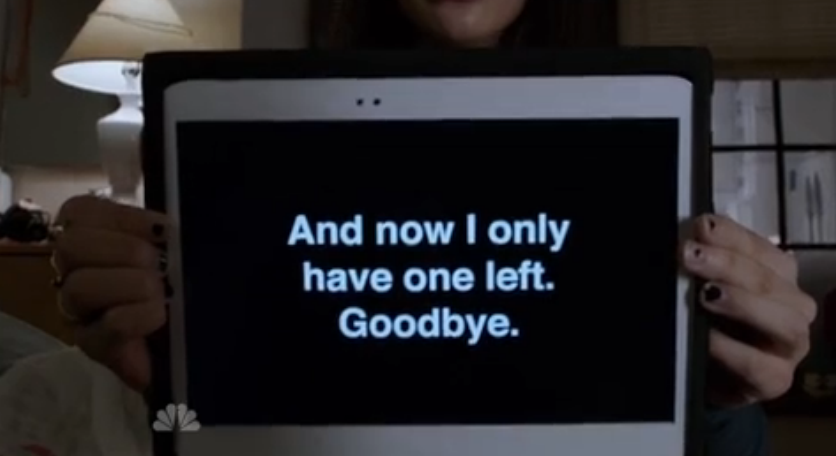
Evie Barnes broadcasts her social death. (Screen capture from "Pornstar's Requiem")

Evie Barnes broadcasts her social death. (Screen capture from “Pornstar’s Requiem”)

After the judge sets aside the verdict and frees Barnes’s rapist, Barnes commits what the show portrays as a kind of suicide, complete with suicide note, where she leaves university for porn. “Pornstar’s Requiem” narrates this as the failure of the agents of state violence to complete a saving mission. Barnes no longer exists, they lost her. Only Roxxxane Demay remains. Demay partially affirms her position telling Collins, “At least here when I say stop, they stop.” But does so on the verge of tears over a funereal soundtrack making that affirmation instead part of the “resort to porn” narrative. No matter that earlier in the episode Barnes expresses a certain fulfillment with her work in porn, “I signed contracts. I got paid. It felt good. I mean these guys [Barnes looks to each side at the men on campus] look right through me. They have no idea what I’m doing on set with hot porn actors.”

Evie Barnes self-medicates before her funeral. (Screen capture from "Pornstar's Requiem")

Evie Barnes self-medicates before her funeral. (Screen capture from “Pornstar’s Requiem”)

Evie Barnes’s social death is finalized on a porn set. Collins tells her, “You don’t have to be here,” and tries to offer her other options. Demay tell Collins, “Once you’re Roxxxane Demay, you can’t be Evie Barnes again,” takes some kind of pill, disrobes and walks to her burial, a gangbang scene with fifteen men as stand-ins for pallbearers.*** This, as with all saving missions, ends with the ‘saved’ being dehumanized by the saviors. The dehumanization that Barnes fights against earlier in the episode is finalized with the heavy, tragic soundtrack, Barnes/Demay’s tears and Collin’s desperate, sorrowful pleading. She is literally dehumanized in this narrative. The human Evie Barnes is dead and Roxxxane Demay, a fictional character invented by Barnes for stage purposes, now exists in a non-life as the title “Pornstar’s Requiem” suggests. Here Collins and Barnes’s rapists are no longer opposing parties, they find shared ground with Barnes’s dehumanization.

Roxxxane Demay approaches her funeral. (Screen capture from "Pornstar's Requiem")

Roxxxane Demay approaches her funeral and walks into the light. (Screen capture from “Pornstar’s Requiem”)

The episode’s end message affirms both agents of patriarchal state violence as sole recourse of accountability (though failed in this instance) to victims of gendered violence and the dehumanization of sex workers. NBC broadcast this message to over two million initial viewers. As with all popular culture, the episode did not invent this message. Instead it (re)produces it in conversation with broader media and popular discourse. “Pornstar’s Requiem” is another exchange in the conversation and in spite of its attempt at critical engagement, it ends up projecting and producing the real-life alienation described by Kross and Knox.

* Kross’s isolated quote can be read to affirm survivor stigmatization.

** Fuck RAINN for throwing a survivor under the bus in its horrible response to the recent Rolling Stone article on the University of Virgina gang rape story.

** The episode strongly suggests a social death and portrays Roxxxane Demay’s evolution as solely horror. There is another interpretation though the show does not point to it in any way at all, what Emi Koyama calls “Negative Survivorship“. Interpreting the scene this way is far better and appropriately positions the agents of state violence with the rapists while supporting Demay/Barnes. Based upon all previous episodes of SVU, this is not the intention of the writers.