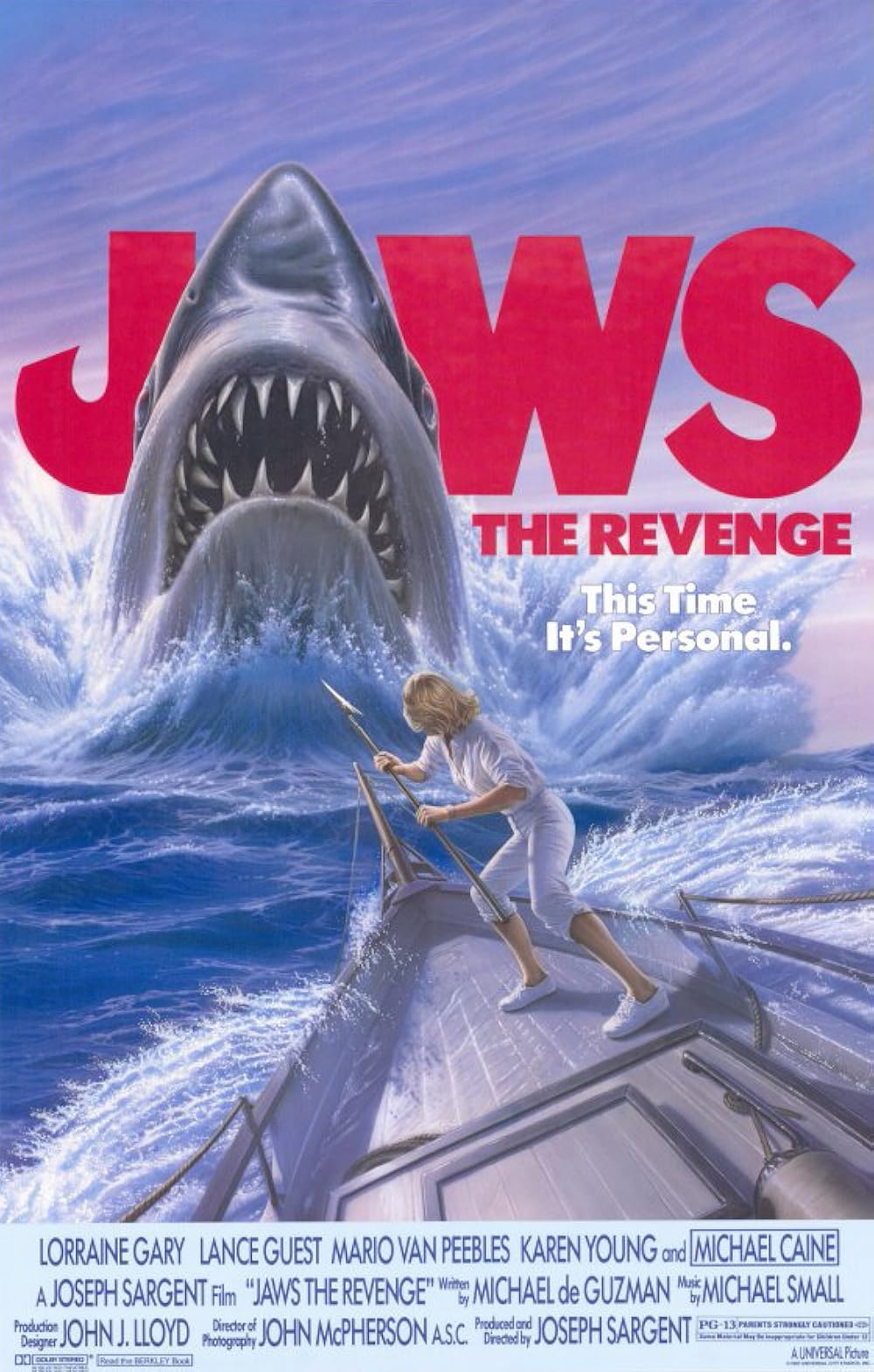
Jaws 3-D, the prior film in the Jaws franchise, is the worst of the four Jaws films. But not because Jaws: The Revenge didn’t try to top it. The final Jaws movie (to date!) takes us back to Amity Island, the fictional Nantucket for another sharks vs. The Brody Bunch tussle. The Brody who carried the first two films though, Chief Brody, is absent from Jaws: The Revenge. As best I can determine from old press releases, Roy Scheider declined to reprise his role because he had dignity. Instead Lorraine Gary carries the lead as his widow Ellen Brody. Gary was wonderful in the first Jaws especially and she has a gift for emotive vocalizations and laughter. Some of that talent creeps into Jaws: The Revenge. Not a lot though.
Jaws: The Revenge opens with Brody’s youngest son getting eaten by a shark while he’s at work at the police station where his dad formerly reigned. The grieving mother joins the grieving brother (Lance Guest) in the Bahamas where he is a marine biologist studying a conch species. But wait, great white sharks do not frequent the warm, shallow waters of the Bahamas, the film tells us (which is true-ish). Will there be no great white sharks in Jaws: The Revenge? Not to worry. A shark has followed the Brody’s all the way from Amity Island. Because….sharks can stalk planes? Astral projection perhaps?
The film doesn’t get any more coherent as it goes along. Very little happens that makes any sense. Subplots are introduced only to be promptly abandoned. Michael Caine phones in a supporting role. A shark sinks a plane. Mario Van Peebles has an inconsistent accent. Ma Brody takes a sailboat on a suicide mission against a shark. The shark, which is seeking revenge for the time it was previously killed, is killed again…somehow. It’s not clear. It’s also not clear why I didn’t turn off the film well before it ended.
Of the four films in the Jaws franchise, the third entry, Jaws 3-D is the only one that has no relation to the others. Two of the central characters mention Amity Island – the site of the prior two Jaws films and where the fourth one begins – but that’s the start and end of the connection. It’s just another shark attack film and shares nothing with the others in the franchise apart from some of the mood music. So either Jaws 3-D is the worst film in the Jaws franchise or it is an unrelated bad film from the mid-1980s. I leave the choice up to you.
Jaws 3-D opens at a Sea World animal prison where we can see droopy dorsal fins on both dolphins and orcas that indicate their depression and physical stress from lives in captivity. We meet Mike (Dennis Quaid), a structural engineer at the park and Kathryn (Bess Armstrong) an animal trainer, along with Calvin Brouchard (Louis Gossett Jr.) the park’s owner. There’s a little more to the characters than that but if the filmmakers don’t invest significant effort into the characters, why should this reviewer? Basically you’ve got a greedy park owner whose greed leads to Man vs. Shark.
Jaws 3-D exists primarily to cash in on the 1980s 3-D movie revival and the success of the two prior Jaws films. It was never anything but a gimmick that, with Gossett Jr. and Quaid, managed to get a couple big names attached. Because of this you’d think the effects would be better but they’re not. The sharks are inconsistent and even the basic underwater scenes look like badly integrated stickers placed onto the film, and that’s not even counting the 3-D imagery which is sometimes fun, but often shockingly terrible. In one major scene they forgot to even have the shark 3-D effect move, it just floats forward.
Like all shark attack movies, Jaws 3-D has a baseline silliness in that it never pauses to ask: Could a shark actually do any of this? Can a great white shark eat two adult men within two minutes? No. It would struggle mightily to do so over two weeks. Can a great white shark chase down water skiers? Also no. The only part of shark biology that they get right is when a great white dies almost immediately upon being placed in captivity. The filmmakers have to exaggerate the capabilities of sharks because they don’t understand that you can build drama around a 16-foot long predator with sharp teeth that can be, in very rare circumstances, dangerous to people. But they’re lazy. So they make up monsters instead.
From one point of view, Jaws 3-D is the third film in the Jaws franchise. But to get back to the point at the beginning of this review, it’s not really connected to any other Jaws film. Instead, let me suggest that it is the unintentional prequel to the 2013 documentary Sea World exposé Blackfish. Like Blackfish, Jaws 3-D explores the violences inherent in places like Sea World. Early in the film we see two dolphins ramming a gate and trying to escape. The film wants us to think they’re trying to escape proximity to the great white shark but Blackfish tells us that they’re probably trying to escape their horrible caged lives. This also changes the meaning of the film. If we know that the staff that gets eaten are cruel jailers and torturers, Jaws 3-D is a tragedy about villains hunting down a couple of noble sharks that are trying to free their mammalian neighbors from their jails. That framing certainly makes the film more interesting, but it’s still not any good.
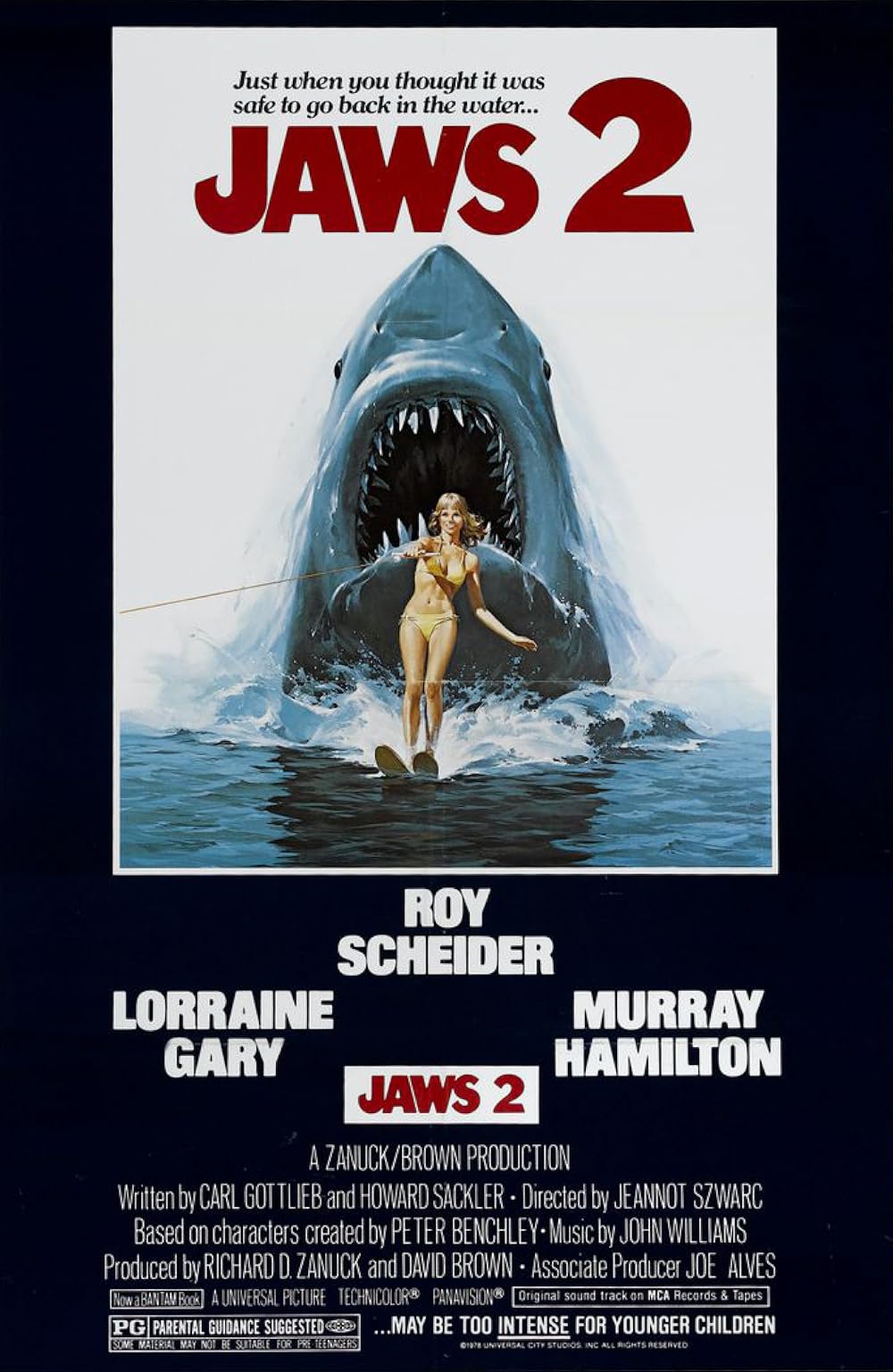
Early in Jaws 2, a great white shark chases down a water skier then bursts through the side of a boat trying to attack the driver. This sets the tone for the nonsense to follow. A great white shark is capable of reaching water skier speeds in very, very short bursts. But it could not chase down a water skier even if it thought to do so, which it would not. This is where Jaws 2 departs from the original and dedicates itself to the future of the shark attack subgenre of horror films. Jaws was a creature feature driven by human characters and intrigue, Jaws 2 is a creature feature driven by shark monstrosity.
Roy Sheider resuscitates his role as Brody, police chief for the Nantucket stand-in of Amity Island. Murray Hamilton also brings back his character of Mayor Vaughn who somehow politically survived the consequences of his awful decisions in the first film. Once again Chief Brody is convinced there is a dangerous shark out there and once again the mayor and city council refuse to act. There is passing reference to a new beachfront development the island government needs to protect from the image of sharks but this is mostly left unexplored in favor of a Man vs. Shark tale of masculinity against monstrosity.
Compared to the first Jaws, Jaws 2 suffers from zero character development, a much worse script and mediocre direction. It is also even sillier. The killer shark destroys several boats, sinks a flying helicopter and eats its own bodyweight over a few days. The being that does this isn’t a shark of any species because sharks cannot do any of the things the shark in this movie does. Except swim. Sharks do swim. Just not as fast enough to chase down a water skier. As I’ve written elsewhere, this is part of creating a monster where in reality there is only a shark. The idea of being even non-fatally bitten by any shark seems unsettling enough to me. Why is it necessary instead to have sharks that are basically a supervillain version of the fish? Surely a 16-foot massive creature with big pointy teeth is enough to develop drama around. Not in Jaws 2 it isn’t.
Jaws 2 is neither the worst shark attack movie nor the worst one in the Jaws franchise. But it’s not good either. There is a brief montage about forty minutes into the film of folks just hanging out, playing, exploring and enjoying themselves at the beach. It’s full of life, joy, emotion and play and is better than the entire rest of the film.
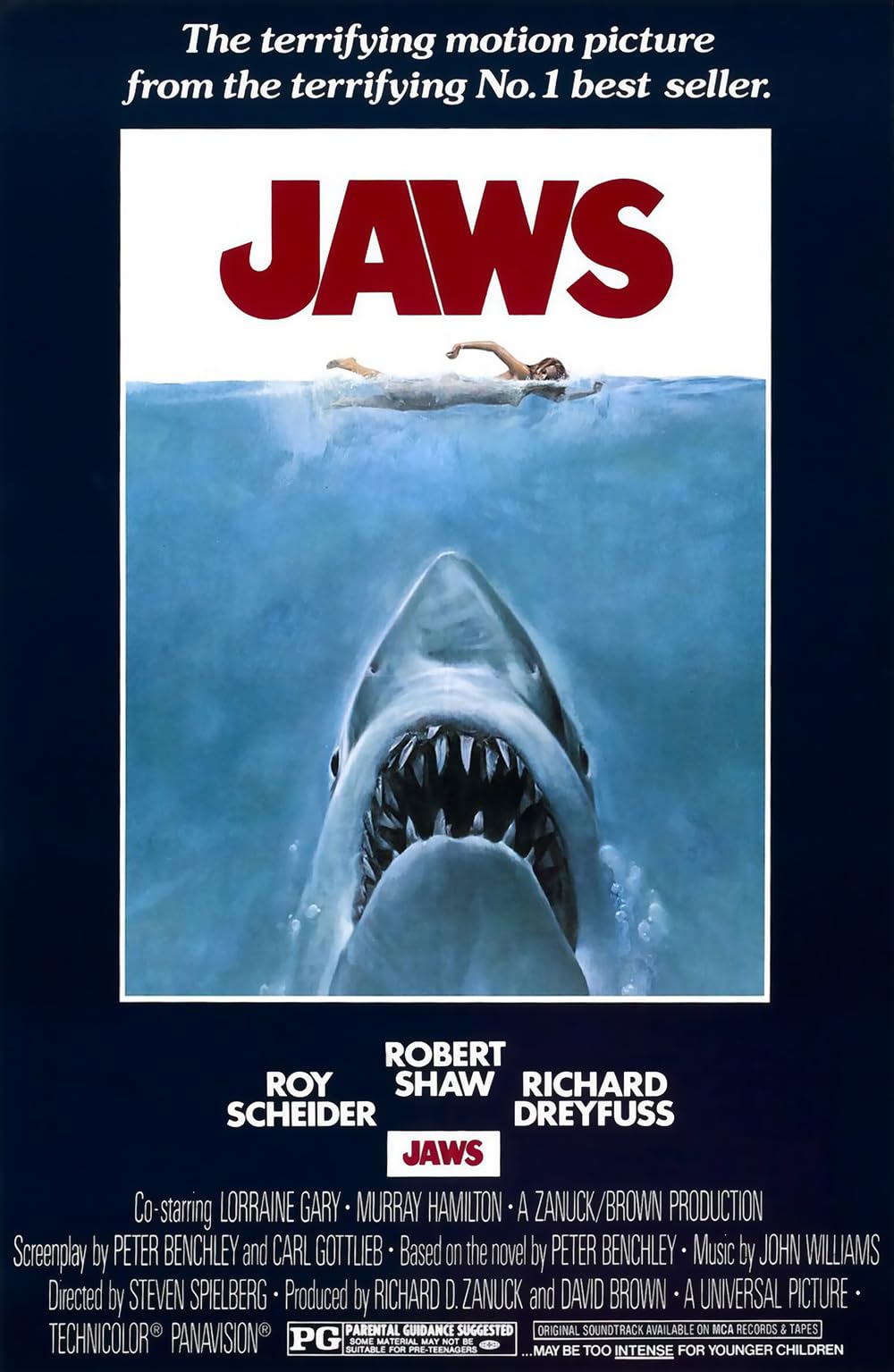
Hidden among Steven Spielberg’s decades long schmaltz vending career are a few good movies. While his technical skills are always evident, as a storyteller Spielberg peaked with a couple of high concept creature features: Jaws and his two Jurassic Park movies. Both of the films spawned entire subgenres of copycats and knockoffs trying to tap into both the narrative and cultural success of the originals as well as launching successful film franchises. Jurassic Park was preceded by several ‘prehistoric monster’ films like King Kong (1933) and dinosaur movies like The Land Before Time (1988, with Spielberg as a producer), but Jaws very nearly launches the concept for the shark attack movie. Prior to Jaws, if sharks appeared in film, it was mostly as background hazards in adventure genre films with a few cameos elsewhere like in the James Bond film Thunderball (1965). And while none of the Jurassic Park derivatives outside the parent franchise have been particularly acclaimed nor commercially successful, Jaws inspired a whole slew of commercially successful films like Deep Blue Sea and The Meg as well as a few well reviewed movies like The Shallows. Jaws was and remains a cultural phenomenon. So what’s it all about?
In Peter Benchley’s novel, Jaws takes place off Long Island but in the film it’s Amity Island, a fictionalized version of Nantucket. The story opens with a drunk kid getting eaten by a shark. Chief Brody (Roy Sheider) searches for the girl and finds her remains. The medical examiner initially finds the girl died of shark bite which sets up the narrative fulcrum upon which the rest of the story, and most of the genre, operates.
Eager to stop news of a shark attack from hindering summer tourist business on the island, Mayor Vaughn (Murray Hamilton) convinces the medical examiner and then Chief Brody to declare that the girl was mangled by a boat propeller while swimming, not a shark. Without this decision, common to all levels of government in capitalist states, to protect capital accumulation instead of the population, the story cannot move forward because the beaches would be closed and there would be no further human infested waters where the shark could dine. But greed wins out, the beaches remain open and the bodies pile up, what’s left of them anway. This is a central point of the genre which usually finds either human greed or hubris – usually scientific – to be the basis that allows for killer shark stories in the first place.
After the death toll becomes politically untenable, a marine biologist (Richard Dreyfuss) convinces everyone it is a shark and the beaches have to close anyway, Mayor Vaughn approves the hire of a professional fisherman, Quint (Robert Shaw) to hunt down the fish. Quint’s subplot is more or less a Moby Dick Cliff Notes, especially his ending! Quint’s dockhouse is filled with mounted shark jaws of various sizes and his hunt becomes framed as personal revenge against the sharks that ate his boatmates after a Japanese submarine torpedoed the USS Indianapolis in World War II. His narrative arc is definitely Ahab’s. Quint and the biologist Hooper invoke Moby Dick again in their comparison of their prior injuries and scars from shark encounters. Quint, Hooper and Brody then quest to hunt down the great white shark that is munching on tourists and locals.
The film becomes increasingly silly as the three leave behind the political economic intrigue that allowed for the shark attacks in the first place. By the incredibly low standards of shark attack movies, Jaws appears practically peer reviewed from a science perspective. It still requires a series of nonsensical decisions and pseudoscientific shark biology in order for the Man vs. Shark portion of the film to build suspense or seem plausible. The shark hunters have harpoons, explosives, fish hooks, pistols, shotguns and more. Any hostile interaction with the shark where the people are not submerged in the water can only plausibly end in one way. In short: people go fishing, fish do not go peopling.
Jaws is very nearly the only shark attack movie, and one of very few animal attack movies of any kind, where the Horror Animal does not eat impossible amounts of food. That the shark continually preys upon people is implausible but since it’s not clear over how many days the narrative takes place, the volume of soylent green (plus one black labrador) the shark eats only moderately stretches plausibility. Some shark attack movies have the shark eating over a year’s worth of food over the course of a day or two. Jaws is positively restrained in having the shark eat only a couple months of food over a week or two. Yet this exaggeration is still part of creating a monster where, in reality, there is only a shark. It’s a puzzle. The film already has capitalism as the monster, as the problem that allowed for all but the first person to be eaten by the shark. Why does it need a second monster? Why can’t the shark just be a shark? Is an animal that does, on very rare occasions, kill and eat people so insufficiently terrifying that it must be exaggerated? And how does killing the shark solve the political problem that put people in harm’s way?
Jaws succeeds as a film for a lot of different reasons. Spielberg does his career best pacing and speeds up and slows down the film at several moments without rushing or dragging. The special effects would mostly pass muster today, unlike its sequels. And most of all, terrific performances from the four lead characters. Sheider, Shaw, Dreyfuss and Hamilton are all stellar with Shaw especially good in bringing to life what could have been an empty archetype. Hamilton as a politician only interested in the tourist economy is wonderful. You can feel the hollow salesmanship when he says, “Amity, as you know, means friendship,” while trying to distract a news crew from the shark attacks they’ve come to cover.
Jaws basically invented the nature horror subgenre of the shark attack movie and remains one of its best examples even after nearly fifty years and dozens of imitators. It is also a film that repopularized sharks as villains and probably plays some role in mass shark slaughters though commercial fishing was already doing that before Spielberg was born because, just as in the film, capitalism is the real monster, the one that magnifies all harm.
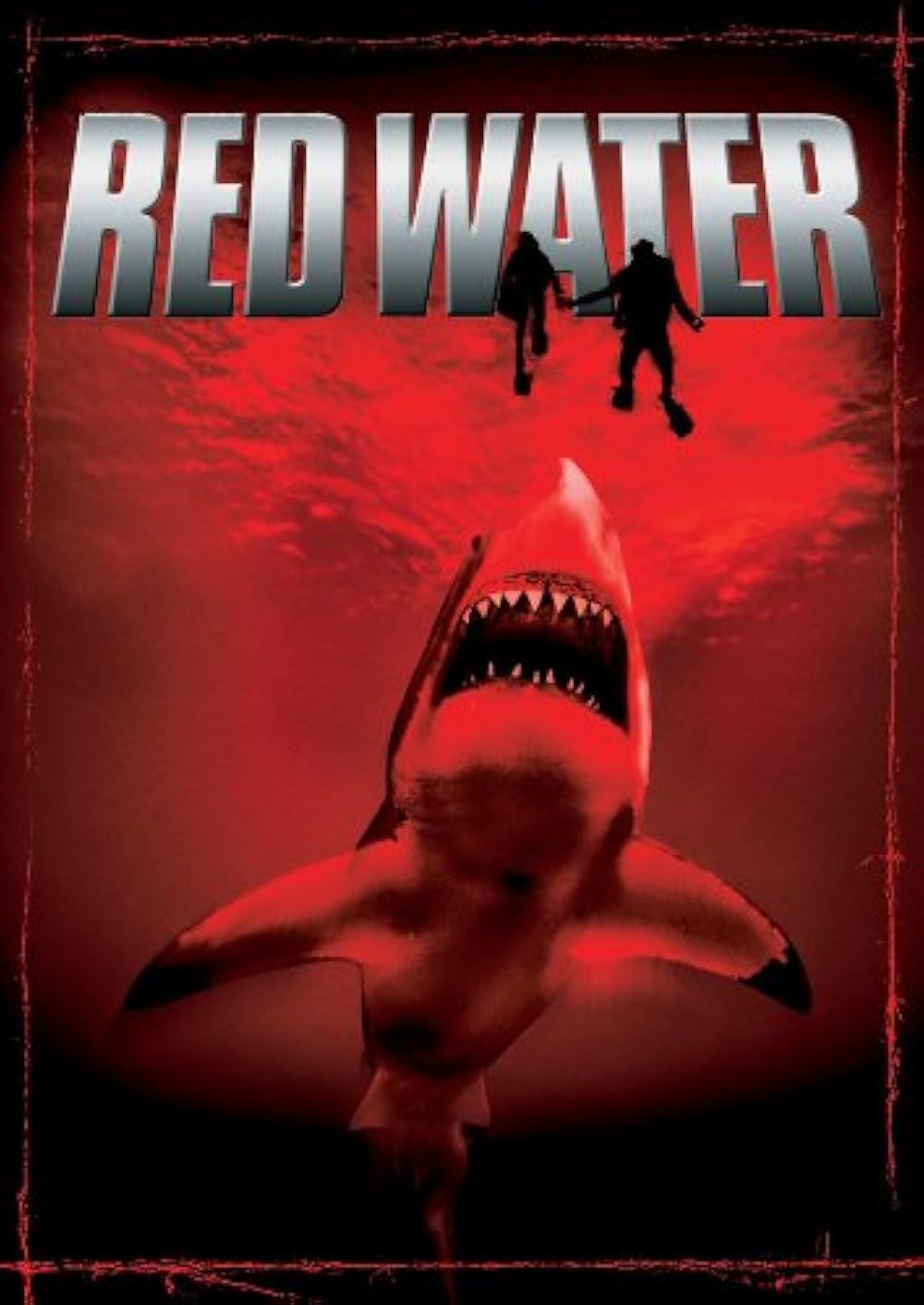
There is a weird kind of masculinist environmentalism in Red Water where organizers who connect ecosystem devastation to war and oil extraction get a deserved comeuppance but thoughtful, individual men can legitimately come to care about the environment only if dragged there by a killer shark. It’s as if it is ok to care so long as you don’t tell anyone about it. It’s one of the only notable things about Red Water, a 2003 TV movie starring Lou Diamond Phillips, Coolio and Kristy Swanson. A bull shark is loose in the Mississippi River and it has killed a few people. Some violent men working for a drug gang are trying to recover drug money from the river bottom are also loose in the Mississippi River and have killed even more people. The oil industry is also loose in the Mississippi River and has killed many millions of people. But somehow the shark is the bad guy and source of horror for the story.
Red Water finds John (Phillips) down on his luck in the Louisiana bayou and needing a big score to stave off the bank from repossessing his fishing boat that is also his house. Along come his ex (Swanson) who is working for an oil company drilling in the river. She recruits John, a former oil worker, to help troubleshoot their drilling problem. On site they run into three men trying to recover money that one of them dumped in the river before a jail term. A series of nonsensical and deeply improbable decisions later and the oil crew and money hunters are at odds with each other as well as a bull shark that is hunting down seemingly everyone. From that point is Man Dodging Bullets vs. Shark until the credits roll.
Like all shark attack movies, Red Water fails to ask: can a shark even do all this? The answer is: No. At one point, a shark appears to kill several people within a matter of minutes. An earlier scene with John’s mentor makes it seem like the shark is eating the people it kills. Which would mean that over the one day the film takes place, the bull shark eats three times its body weight in soylent green. If we understand the early scene where a fisherman laments the lack of catfish to mean the shark has eaten those catfish, then it has eaten an even larger quantity of its body weight. No shark can do that. Nor does it randomly vary its feeding ground over such a wide area in such a short time. But since, somehow, filmmakers cannot imagine being killed and eaten by a shark to be a terrible or terrifying event, they have to create a monster in its place in order to approach horror.
Red Water isn’t a remarkable film. It would be a pretty standard heist film or shark attack movie and it’s very slightly novel that it combines the two. It’s reasonably well shot and paced and, apart from a couple of spots, the shark effects pass muster for a 2003 film. The performances surpass the budget but the budget is low so that’s not much to brag about. Overall, it’s kinda weird and you could do a lot worse.
Shark Bait asks a very common horror genre question: What if a bunch of young, good looking people without the skills to survive an untied shoestring were all of a sudden in a situation with a high probability of death? Sometimes this means they’re at a summer camp and an abnormally violent hockey goalie (or his mum!) is stalking them like in Friday the 13th. Sometimes a knife wielding incel with daddy issues starts going after his schoolmates like in Scream. And sometimes, like in Shark Bait, a bunch of annoying tourists find out the consequence of their actions is a very hungry shark.
Shark Bait opens with young American tourists in Mexico partying on an ocean beach. They get drunk and the following morning decide to steal two jetskis and head out to the ocean for some drunk driving without life vests. Two of the dudes wreck the jetskis while dick measuring which leaves the three men and two women stranded far out to sea. From there it’s Humans vs. Shark until the credits roll.
Shark Bait uses a bunch of the most common horror tropes. A girl shows her breasts therefore must die because The Whores Must Be Punished! in one of horror’s more misogynist premises. No clear and obvious solutions can be pursued like: turn the other jetski over and see if it works or tie them together for a larger surface. There is even a Final Girl who develops Final Girl Skills out of nowhere, perhaps from her purity ring.
Shark Bait also deploys the silliest part of all shark attack movies in that the filmmakers never think to ask: can sharks actually do all this? Can one adult great white shark eat five adult humans over 24 hours? Not even if it was the shark Joey Chestnut. Do great white sharks pursue speedy prey over long distances? Also no. A few species of sharks on very rare occasions, do kill and eat people. It’s hard to imagine going through something that horrible and terrifying. Yet, somehow, filmmakers do not understand that being eaten by a shark is horrible and terrifying so they have to exaggerate the shark’s capabilities to create something monstrous in its place. Less of an issue but still a scientific puzzle is: where are the remoras? You’d think in one of these shark attack movies there would be a couple of remoras scooping up people crumbs from the sharks but, nope.
Shark Bait is well shot and paced but weighed down by a bad script. The story is thematically bad, full of cliches, and odd decision making, and has British phraseology that sounds off through American accents. Usually American accents anyway. All of the actors drop their accents at some point, usually while yelling. The performances were fine, especially Cat Hannay, but sometimes it was pretty obvious that there were some gaps in their White American Non-Regional Diction practice. And really, if they had been bad actors it wouldn’t have changed all that much. There’s only so many different techniques you can use to shovel cliches. All in all, a run of the mill shark attack movie where you root for the shark a little more than in most others. Because tourists are awful.
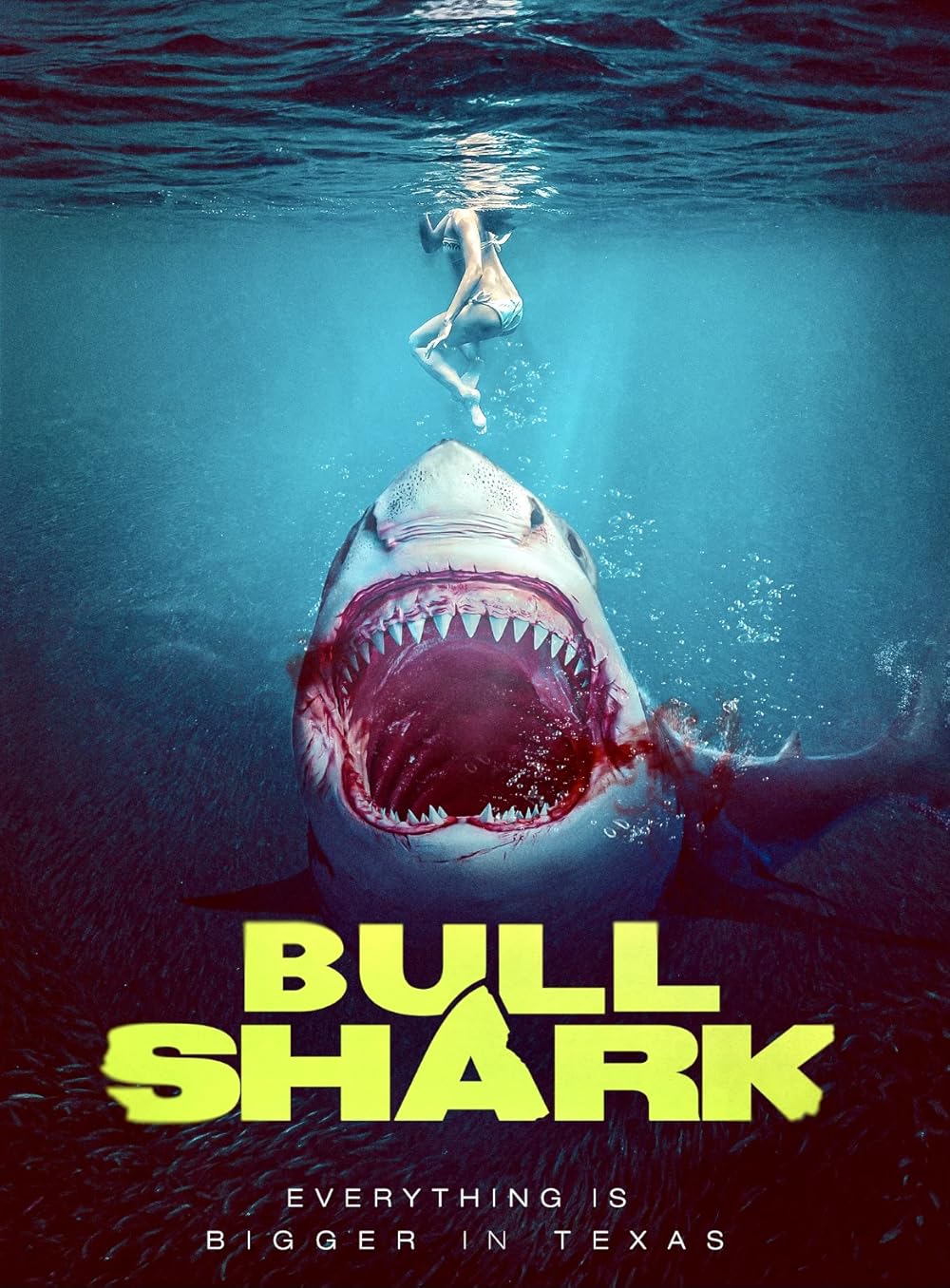
Bull Shark is a study in wildly divergent quality within the same project. The film is well shot and the main cast is up to the task. On the other hand, the script is terrible, as are the effects. It makes you wonder what they could’ve accomplished had they the budget for professional rewrites, better effects and even near competency for the bit parts (such as the wildly overacting fisherman).
The plot is lifted directly from Jaws. They swap out Nantucket for a north Texas lake and the sheriff for a game warden and a great white for a bull shark but otherwise it’s the same story with the same message. A mayor concerned about protecting tourism incomes refuses to close the beaches despite a young girl being killed by a shark. The shark then kills more people and leads to a main protagonist vs. shark final battle. Sure, the details are all different, but it’s just a low budget Jaws in Texas where at least one thing, shark movies, are not bigger.
Bull Shark shares with all shark films a silliness inherent to the genre. The bull sharks in question simply cannot do the things the sharks in the movie do. The first person is killed and eaten by a newborn bull shark pup. While I’m sure a bite from a 2.5ft baby bull shark could be quite unpleasant, it’s hard to imagine it being able to kill an adult human. Nor could it eat multiple people over the course of the film. Sharks just don’t eat as much as they are purported to do in these movies.
So far as micro-budget shark films go, you could do a lot worse than Bull Shark. It’s not really a good film, but is somewhat watchable due to camera competency and a couple strong performances. Can’t really recommend it but if you’ve lost the remote and can’t get to the TV because your cats are sitting on you, it could be a lot worse.
John Turteltaub’s 2018 nature horror film The Meg, based upon the novel Meg, has a budget over $130 million dollars, state of the art special effects, and a cast of multi-award winners including Cliff Curtis, Li Bingbing and Rainn Wilson. That sounds like a recipe for a rollicking creature feature. It’s not. Here we go.
The film begins with Jason Statham – playing the same role he always does – as Jonas Taylor, a deep sea rescue specialist. Jonas is shamed by colleagues for his perceived failure in a submarine rescue where ‘something’ attacked the submarine and most of the crew was lost. He is pulled away from a life exploiting Thai fishermen and drunk driving near child pedestrians when his ex-wife is part of a scientific expedition gone wrong and only he can rescue her. She and her crew are exploring a silly idea that the sea floor of the Marianas Trench isn’t actually the sea floor. Instead a whole world of sea life has been partitioned off there for over two million years. It’s Doyle’s The Lost World only with more fish and less racism. During the rescue a couple megalodon sharks, an extinct species that grew to an estimated 38ft that the movie doubles, follow the rescue teams back to the research station. Hijinks ensue and it’s Man vs. Shark for the remaining run time.
The Meg shares a problem with all shark attack cinema that I’ve written about before. We first meet the megalodon when it eats an improbably giant squid that, with a mantle length that looks to be around 20ft, probably weighs a solid 4,500 lbs. That shark is done eating for the duration of the film. When the next megalodon eats that shark, that shark too is done eating for at least a couple weeks. But the shark cannot eat like a normal shark would. If it did its monstrosity would be unremarkable and there goes the entire sub-genre of shark attack movies. It’s a little stunning actually, that so many filmmakers struggle to make a shark attack horrific without grossly exaggerating what sharks are capable of.
But the primary flaws with The Meg are not scientific. They’re poetic. Turteltaub interrogates no cliches and uses what seems like all of them. They left all character development on the cutting room floor. There is a romance subplot between Li and Statham that has less convincing chemistry than your average anti-vaxxer analysis. Using a script this bad on performers as great as Li and Curtis is depressing. The only thing that separates it from Shark Attack 3: Megalodon or any of the other ‘Jurassic Shark’ themed movies is budget. The Meg’s is conspicuously higher which improves its standing in comparison. The Meg isn’t an especially bad film. Just a generically bad one. Which is a shame. If it wasn’t so corny or if it hadn’t taken itself seriously, perhaps it could’ve been a bit of fun at least.
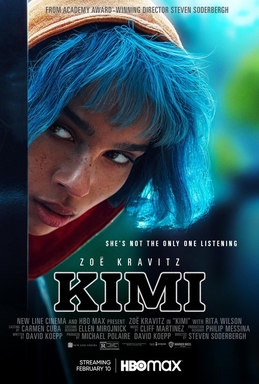
There’s an apocryphal quote attributed to John Maynard Keynes saying, “Capitalism is the extraordinary belief that the nastiest of men, for the nastiest of reasons, will somehow work for the benefit of us all.” Everyweekanotherreportcomesoutabout how tech companies are producing another app or gadget to make our lives more convenient and connected and instead are reproducing racism and misogyny that reminds me of that quote and how silly it is to imagine they would, or could, do anything else. Into this world in February director Steven Soderbergh brought us Kimi.
Zoë Kravitz stars as Angela, a tech worker for a company making Kimi, a device similar to Siri, Google Assistant or Alexa. Angela works from home and is carrying heavy earlier trauma that makes it a supreme challenge to leave the house even after the end of Covid lockdown protocols. Her job is to help resolve Kimi’s various failures to understand as, in order to properly function, Kimi needs to understand that: pop, sodapop, soda, soft drinks, cokes and more are all terms for the same thing, mostly varying by region. Sometimes she’s resolving these issues, sometimes just figuring it out that it’s kids messing with the app, and then she encounters something much worse. The something worse threatens the bottom line of a tech firm expecting an influx of cash and they’re willing to do anything to protect it.
Soderbergh starts the film with a slow build for the first fifty minutes and then, in one of my favorite little narrative tricks, has Angela start sprinting towards the finish at the same moment the story does. As we’ve come to expect from Soderbergh, Kimi is briskly paced and terrifically scored. It’s also more thoughtful than your average thriller with Angela having to navigate harassers, creepy stalkers and misogyny broadly to her advantage to even get to the end climax.
This is no one involved’s best film but that’s a lot to ask of nearly every film. Kimi is a good bit of fun. It takes familiar tech age tropes and turns them into a thriller with a few nice spots of dark comedy that peak with Jaime Camil’s ‘uh oh’ face that few can do better. Kravitz carries the lion’s share of the story and manages to be terse, troubled and nearly joyless without making the story itself joyless. As the film comes to climax and the tech firm and tech try to carry out their respective plans we get to see which one can .exe better.
As ugly as Soderbergh paints the tech industry in the story, it still seems kinder and gentler than the real world tech industry. Murder-for-hire seems almost quaint next to Apple production contractors installing suicide nets to keep workers from flinging themselves from the roof of factories or Amazon workers having to pee in bottles as bathroom breaks would drop their productivity while the company works to bust unions or how the entire web3 scene is “Amway but everywhere you look people are wearing ugly ass ape cartoons”. But what Angela teaches us is that maybe what we need to do to heal from Covid’s isolation, from the horrors inflicted upon us by Silicon Valley, is to take down these vile firms. And if we use her methods, who knows? Perhaps all things are Kimi-possible. Thanks for reading and sorry for the Kim Possible puns!
Rolling Stone on 10 June 2020 published a terrific article by EJ Dickson titled “Racism in Porn Industry Under Scrutiny Amid Nationwide Protests”. Dickson interviews Ana Foxxx, Ricky Johnson, Demi Sutra and others who lay out strong critiques of the porn industry’s anti-blackness: how it produces anti-black imagery and how agents, porn companies and producers, along with performers who go along with or embrace it, create a rigidly racialized economic caste among performers with black performers being denied opportunity after opportunity. Dickson towards the end of the piece quotes a white producer for the white-owned Vixen Studios subsidiary Blacked.com. Dickson writes that Mike Moz “defended the practice of offering higher rates for white performers doing their first scenes with black men” with Moz saying, “Within the industry, any kind of first has a value on it. You’re vying for those firsts.”
I quoted several performers in an earlier piece about the “firsts” Moz refers to and how this creates a separate job entirely for black performers:
The higher earning potential happens in two ways. White women performers, especially successful ones, often follow a progression of roles. Lexington Steele describes it, “There are situations where it could be the industry, whether it’s her boyfriend, her husband or management that suggests she either doesn’t do [interracial] at all, or waits until a certain time when her rates can appreciate over time. Where it’s: girl-girl to boy-girl to anal to DP [double penetration] to, and then the ultimate she can charge her most is when she finally does interracial.” This is career path is unavailable to black women performers whose scenes are always already “racial” but never “inter” from an earning perspective, even when explicitly pointed out as such. For example Nyomi Banxxx recalled about a scene with a white male performer, “I had this conversation with my agent. I had this conversation with a director, because we were arguing about rate. I said, ‘I need to get paid for an interracial rate, IR.’ ‘No that’s not IR.’” This is one reason why Misty Stone says, black performers “do the same amount of work but [white performers] get different opportunities.
The “firsts” Moz defends are a series of sexual acts with ‘black’ being the most expensive act white ciswoman performers can do. Here black is both a subject position and sex position that subordinates and stigmatizes black performers. It says, “Look! A Black!” in the exact same sense Fanon means. This gives lie to Moz’s claim that Blacked will no longer “use terms like ‘BBC’ and ‘interracial’ in its marketing copy.” The subject and sex positions are in the very name “Blacked”. It implies interracial through using black as a verb, a transgression action crossing a border between subject positions, contaminating white purity. If Blacked is truly ending it’s use of the term “interracial” in marketing then it is simply substituting “Blacked” for it as interracial was always redundant to the company name.
When the unnamed director told Banxxx, “No, that’s not [interracial]” to her demanding a higher rate for doing a scene with a white performer, they demonstrated porn’s anti-black labor regime, how it uses black as a verb to describe a contaminating, corrupting element. Black women are prohibited from this being already “Blacked”. The industry constructs this labor regime intentionally. One quite lightskinned black performer told me years ago that her agent did not want her to market herself as black so she would have better economic opportunities in the industry if coded as ‘latina’ or ‘Asian’. Anti-blackness explicit in the industry as Dickson’s article lays out and Moz confirms and as Ana Foxxx, Ricky Johnson, Scarlett Bloom, Demi Sutra, Lotus Lain and so many other performers have been campaigning against for some time, including increasingly publicly outside of the sex work industry over the past couple weeks.




 CiCo3
CiCo3 