Punished to Perfection

SPOILER ALERTS for the “Ride the Lightning” episode of Criminal Minds and V for Vendetta comics and film. Many thanks to Zoé Samudzi for early feedback on the idea. Mariame Kaba, Critical Resistance, Ruth Wilson Gilmore and other Black liberation and abolitionist organizers have long described and critiqued the same ideas and credit for anything insightful in what follows is due to them even if not directly cited, although they should not be blamed for any misuses of their ideas. Please support their work. Feedback whether constructive, destructive or other is always welcomed.


The fourteenth episode in season one of the CBS police procedural Criminal Minds, “Riding the Lightning”, follows the FBI’s Behavioural Analysis Unit (BAU) as they interview Sarah Jean Dawes and Jacob Dawes, a white serial killer couple scheduled the following day for execution in Florida after being found guilty of killing twelve young women plus their infant son Riley. The interviews reveal that Sarah Jean was uninvolved in the killings and was a herself victim of Jacob’s abuse yet the BAU, despite finding Riley alive, doesn’t intervene against her murder by the state. The episode creates a sympathetic saint through martyrdom while punishing someone towards their perfection and it is not alone in its carceral saintmaking. It is representative of very common narratives and assumptions that brutalizing people improves them.

“Riding the Lightning” opens with BAU agent Jason Gideon (Mandy Patinkin) having a teary, appreciative smile on his face while listening to a live performance of Bach’s “Cello Suite No.1, Prelude”. It transitions into the interior of an FBI vehicle where BAU agents Gideon, Derek Morgan (Shemar Moore) and JJ (A.J. Cook) are discussing the killing carried out by married couple Sarah Jean Dawes (Jeanetta Arnette) and Jacob Dawes (Michael Massee) while the rest of the unit similarly discusses in another vehicle. A team led by Gideon interviews Sarah Jean while Hotchner (Thomas Gibson) leads Jacob’s interview.

We meet Sarah Jean when Gideon visits her cell where she is painting. Sarah Jean exudes a weary serenity, wisdom and peace that has Gideon questioning whether she killed Riley and, later, whether Riley is even dead. Jacob is her opposite. He revels in sexual violence, enjoys taunting the BAU and lasciviciously celebrates his misogynistic history.

The episode follows the BAU’s divergent interviews with Jacob and Sarah Jean. Sarah Jean is contemplative, nurturing and wise while Jacob is vicious, creepy and mocking. Through probing interviews directly against the boundaries Sarah Jean tries to enforce, the BAU figures out by using very implausible psychology that, not only did she not kill her son Riley at Jacob’s directive, but she didn’t kill him at all and the boy is alive, adopted by a rich family. Meanwhile Hotchner engages in a regressive masculinity contest with Jacob.

The episode climaxes with the BAU frantically searching for and finding the proof that Riley is alive while Jacob is executed. At the moment right before Jacob’s face is hidden from the murder viewing room, Hotchner slaps a picture of a now teenaged Riley up to the glass telling him, “You lose!” Jacob is at last not gleefully lecherous, providing for the audience a comeuppance for…someone seconds away from being executed? Morgan and Elle find Riley but Gideon orders them to back off after deciding to heed Sarah Jean’s wishes and letting the state kill her, ostensibly to prevent Riley from being contaminated by his association with his parents. Sarah Jean requests that Gideon witness her murder which he does while the warden, tears in his eyes knowing she didn’t kill her son, over a sad melody, sees to her death.

Even by the standards of pro-death penalty US cop stories, the FBI, warden, and condemned teaming up together to execute a sympathetic character consciously against the evidence is a little remarkable. Jacob’s murder, because of Hotch’s actions, intends audience pleasure. Sarah Jean’s murder/suicide bonds those not killed together, witnessing while manufacturing her martyrdom and beatification. It is their act of jointly killing her that makes them heroic and her willing walk to the electric chair that makes her a saint. It is the act of punishing her that brings her to the ethical sublime. Despite the terrible writing – Criminal Minds is always mediocre from the perspective of canon consistency and psychology but rarely is it as corny as “Riding the Lightning” – the episode is one of the more moving ones. The “heroic” death of a sympathetic character is deeply affecting. All state murder is horror yet Criminal Minds finds a way to not only make it heroic, but virtuous even in the context of executing someone who didn’t do the thing for which they’re being executed.

V for Valorus Victimizing

In both the 1982 comics series by Alan Moore and David Lloyd and 2005 film directed by James McTeigue, V for Vendetta offers another version of punishing someone to righteousness. The comics and film have some differences – for example in the comics Evey is a sex worker and in the film a tv production assistant – but in both Evey Hammond is imprisoned and tortured to heroism. “Riding the Lightning” takes place inside the Criminal Minds version of a Florida concentration camp (euphemised in US discourse as a deracialized “prison”) while Evey’s torture at the hands of V takes place in a mock concentration camp of V’s creation in a post-apocalyptic fascist London.

In both the comics (issues 6 and 7) and film, V imprisons Evey in a dark, cold cell, starves her, beats her, drowns her, gaslights her, verbally denigrates her and threatens her with execution. While jailed, he slips her written letters through a hole in the wall from another purported inmate, Valerie, telling her story of how she was captured, tortured and experimented on for being lesbian, and the beautiful parts of her life and loves prior to her time in the concentration camp. These letters shore up Evey’s resolve to not give up “the last inch” of herself even as V seeks to torture her into doing exactly that. In both versions Evey refuses to snitch at the point of death, at which point V exposes the ruse.

In both versions Evey initially responds reasonably, with rage and horror directed not at the fascist system of torture and prisons, but in V’s reproduction of it. Yet she quickly comes to embrace this as a lesson in freedom. V has tortured her in and into service to the greater good. What makes this so effective in the stories are Valerie’s letters. Concentration camp narratives are nearly always devastating and the version written by Moore and reproduced in the film is gutting. It is this affect that allows for V’s actions to be interpreted as reasonable. Without Valerie’s narration, V’s violence against Evey would seem as baldly cruel as it actually is.

This, like the Criminal Minds episode above, reproduces fascism in order to serve the greater good. In both versions reproducing fascism is simply making more of it even as both versions imagine themselves as doing so to produce justice and confront repressive violence (misogynistic killings in the Criminal Minds, state authoritarianism in V for Vendetta). They do not intend to be the same politically. Criminal Minds aspires to validate the carceral state while V for Vendetta aspires to anarchist revolution. Yet they both imagine carcerality to potentially produce justice, to manufacture better people. In the case of Criminal Minds this extends to the jailers who are the story’s surviving heroes.

After the Holocaust…

Everyday discourse naming judges as “justices”, carcerality (Black Captivity) as “the justice system”, prisons and jails as “reformatories” and more all produce the ideas that prisons serve some kind of good. So it isn’t really surprising that popular culture, even dissident narratives like V for Vendetta, reproduces this. But lots of leftist or progressive narratives also do. Anyone who has done work towards Palestinian liberation for much time has heard at least once “I can’t believe Jews could do this after the Holocaust” or some version thereof. Leaving aside the ahistorical, wrongheaded and confused timeline and conflation of “Jews” with “Israeli settler state”, this idea has the same premise as “Riding the Lightning” and V for Vendetta in brutalizing people to righteousness.

That it is surprising that a state calling itself Jewish can perpetrate the dispossession of Palestine and Palestinians in spite of the Holocaust assumes that the Nazi’s concentration camps produced something other than conformity, horror and death (and has a bizarre romanticization of ethnonationalism!). Jews – and other Nazi victims – were just people before the Holocaust. Survivors came out also as just people, if horrendously traumatized. Concentration camps cannot produce righteousness in the material world any more than they can in Criminal Minds or V for Vendetta. The same logic would ask, “How could Palestinian merchants as victims of Zionism – including mass incarceration – in Palestine exploit Black people in the US?” Israeli prisons no more make angels of Palestinians – individually or collectively – than Nazi concentration camps make angels of Jews. That is not what concentration camps are designed to do and it is true horror that they are imagined to do so.

Do you feel remorse?

The above three examples deal with three concentration camps, one real and two imagined (though one purports to reproduce a real US concentration camp). In the material world functioning of US concentration camps parole boards ask detainees summoned to plead for their freedom questions, often something like, “Do you feel your sentence fits the crime you committed?”, “Do you feel remorse for your crime?” and “What would you do different if you found yourself in a similar situation again?” In other words, “How did your time in the concentration camp make you a better person?” Black Captivity’s concentration camps are expected by parole boards to produce contemplative, remorseful people when what prisons produce is primarily violence, isolation and boredom. And if you don’t answer the questions in a way that suits the board, you can be redenied your freedom (to the very limited degree that parole is any kind of freedom). The assumptions of Criminal Minds, V for Vendetta and some progressive activists are the same as parole boards.

This is a way carceral normativity is (re)produced in normative popular culture, surprisingly large swaths of counterhegemonic discourse and by prison functionings themselves. It is the imaginary “rehabilitative” quality of concentration camps when no amount of individual transformation could ever be expected to avoid systemically produced incarceration in the first place. This is, to use Mariame Kaba’s twitter handle, “prison culture”. Thanks for reading.

Every possible story but the true one

This essay is greatly informed by analytical and ethical frameworks developed by Christina Sharpe, Frank Wilderson, Saidiya Hartman, Fred Moten, Che Gossett and others along with Marcus Rediker’s historical research even where not directly cited though they cannot be blamed for my failings. Specifically I use Rediker’s historical scaffolding in his essay “History below the water line” which I abuse to talk about shark attack movies. Should you find this essay engaging please uplift their works, the directly influential ones being listed at the bottom. Special thanks to Megan Spencer for their valuable feedback on the draft and to both Megan again and Zoé Samudzi for being thought partners on the ideas while writing. I try to avoid detailing anti-black violence yet found no way to escape implying or vaguely describing some easily imaginable and horrible scenarios so a HUGE CONTENT WARNING FOR ANTI-BLACK VIOLENCE AND AFRICAN SLAVERY is in order. Feedback whether constructive, destructive or other always welcomed.

The 2018 box office hit The Meg proved that the shark attack film remains a staple of the nature horror genre. The Meg has already a sequel in development and spawned a knockoff in the same year, Megalodon. These focus on groups of people under threat from one or many otodus megalodon sharks, a species extinct for over two million years that grew as large as fifty feet long. Others in the genre look at contemporary species like great white and bull sharks, lab-created super genius sharks, sharks in unexpected places like under the sand or in Australian supermarkets, shark-cephalopod hybrids, sharks using storms to migrate and hunt, sharks from beyond the grave and more. It seems just about every possible and a great many more impossible stories of sharks eating people has been told in nature horror, except for the one time that people were regularly, over a long period, eaten by sharks: the Middle Passage.

Most shark species cannot kill people and almost all those that can never think to try as we great apes largely do not register as prey items, not to mention that sharks struggle to hunt outside the water where all people are very nearly all the time. The small number that do sometimes bite people largely do so while being harassed or out of curiosity (a light biting is a ‘what’s this?’ investigatory technique – though this can still be fatal to people). The even smaller number that on rare occasions attack intending to prey often mistake people for more familiar mammals like seals or bite while attempting to procure something attached to a diver as with the catch on a spearfisher’s string. A couple of species are both capable of killing people and also generalist predators that can sometimes register people as potential prey. Only three shark species are confirmed to account for more than ten total human fatalities, the great white, tiger and bull. A fourth, the oceanic whitetip, likely accounts for many fatal attacks in remote, open waters unlikely to be recorded.

Despite the rarity of attacks, sharks occupy a primary location in colonial productions of nature horror – a genre positing a perpetual threat to “man” from an Othered animal or vegetal being, especially animal attack movies. Sharks are imposing beings and larger sharks are capable of tremendous power and rending of flesh in the course of their feeding. And given that people do travel over or swim in waters where sharks live or frequent, let’s call these human-infested waters, the very rare human-as-calories tragedy is inevitable. The potential for horror here is visceral and obvious. Val Plumwood’s essay “On Being Prey” reflects upon her experience surviving a predatory attack by a saltwater crocodile in the north of the Australian settler colony. She describes it as “an experience beyond words of total terror”. The idea of being killed and eaten, or being killed by being eaten, is necessarily horror. This would be the case even if colonialism did not create “a masculinist monster myth” of order being synonymous with human dominance, a “master narrative” of control over and distance from ecological systems, a counterposition of humanity-animality.

Yet for all the horror of the idea of being prey, there is a total lack of malignance in that fate even as many nature horror stories project ideas of diabolical intent upon attacking animals. They were hungry and there you were or, they were wary of your intrusion and you intruded. It’s not a malignant calculus any more than a chameleon has a grudge against a grasshopper. The violence is strictly mis/opportunistic and the individual creatures involved are incidental, just the right combination of lucky/unlucky that defines predator/prey encounters. This is not the case in the Middle Passage. Humans as shark prey in the Middle Passage has purposeful intent from the terroristic to the punitive to the arbitrary. The horror is malignant not by the sharks’ actions, but in how slavers made captive Africans into shark food. Think Jaws combined with Saw combined with Hannibal and you’re in the ballpark, albeit far less horrifying than the actual details which I recommend against investigating for traumatic reasons but also ethical ones around the drive to consume and reproduce anti-black violence.

During the Middle Passage, slavers fed murdered and living Africans to sharks as a convenient disposal of murdered remains and troublesome persons, to terrify surviving captives against escape or suicide overboard, to punish captives involved in insurrections and more. Slavers describe all of that in their contemporary narratives as well as Africans escaping ships to unknown fates including repatriation and liberation as well as death by shark. Slavers murdered at least two million Africans during the Middle Passage and discarded nearly all into the Atlantic. Sharks did not consume all these souls, but they consumed many. If sharks consumed just 1,000 of those dead or living – I found no estimates, reliable or otherwise, but 1,000 is at least a factor of ten below a wildly conservative guess if their frequency in slaver narratives is representative – that would still be nearly 20% higher than all combined fatal and non-fatal shark bites/attacks in the Florida Museum global database hosted by the University of Florida that tracks shark attacks since 1582, and 85% higher than the total verified fatal shark attacks. By any measure, the Middle Passage accounts for the overwhelming preponderance of cases of people being consumed by sharks. The percentage, though unknown in detail, is sufficient to say that it is the the “normal” way sharks eat people with all other examples being statistically peripheral (This if my readings of shark ecology are correct in concluding that most historical ocean-going ships travel too fast for sharks to pursue longer than briefly or are otherwise not attractive to sharks leaving lesser probabilities for shark predation in the event of shipwreck, even incorrectly assuming a historically and geographically flat population density of sharks per square kilometer and oceanic shipwreck distribution).

The Meg, it’s knock-off Megalodon and its pending sequel, 2002’s Shark Attack 3: Megalodon and an earlier Megalodon from the same year, 2012’s Jurassic Shark, 2009’s Mega Shark vs. Giant Octopus or any of the Mega Shark franchise, 2011’s Super Shark and the 2001 Antonio Sabato Jr. vehicle Shark Hunter account for ten of the feature length films about an extinct shark hunting people, a species that never once encountered any great ape in its millions of years of existence. There’s nothing inherently wrong with this. Sci-fi doesn’t have to have much sci in it to be a fun or good story. Over ten impossible megalodon films but not one involving the predominant context of material world consumption of people by sharks. Why are our imaginary universes so rarely grounded in material violences like the Middle Passage? This isn’t just the sci-fi shark attack stories like The Meg, Sharknado and 2-Headed Shark Attack.

I earlier argued that nearly all shark attack films are sci-fi in that sharks are not, as a rule, capable of consuming as much food as they do in shark attack movies. An adult great white shark cannot eat hundreds of pounds of people in two days like in The Shallows, much less in minutes as with Jaws 2. But even in those films portrayed as real-world like Jaws, I’m aware of none that take place in or reference the only historical geography where shark attacks on people were common and predictable. There are films like Frenzy and Open Water with divers and boaters marooned in remote areas in the face of hungry sharks but none of actual marronage from both slavers and their accompanying sharks. This has always been the case in film and tv but not in other mediums.

Petition of the Sharks of Africa

Petition picture from the University of Virginia website

Scottish abolitionist and radical James Tytler produced in 1792 an early science fiction work in his “The PETITION of the SHARKS of Africa” addressed “To the Right Honourable the Lords Spiritual and Temporal of Great Britain, in Parliament Assembled”. In the petition, sharks collectively beg Parliament to not heed the demands of abolitionists as it will deprive a “numerous body” in “a very flourishing situation” of “many a delicious meal” of “large quantities of their most favourite food” over “the specious plea of humanity” that is abolitionism. Abolitionists made much out of the horror of slavers feeding captive Africans to sharks.

Slavers Throwing overboard the Dead and Dying—Typhoon coming on

JWM Turner 1840 painting: Slavers Throwing overboard the Dead and Dying—Typhoon coming on. Picture from Wikipedia

J.W.M. Turner’s 1840 oil on canvas Slavers Throwing Overboard the Dead and Dying, Typhoon Coming On (also called The Slave Ship) horrifically foregrounds a slave ship rollicking in heavy seas with sharks setting upon “the dead and dying” Africans-made-into-commodities thrown overboard. There are other pamphlets, poems, paintings, media accounts and more.

Yet fantastic fiction canon bibliographies do not mention Tytler’s text. The Museum of Fine Arts in Boston that displays Turner’s painting describes it as “a striking example of the artist’s fascination with violence both human and elemental” but does not mention the sharks in the painting, no matter that the foreground dominates the canvas. It goes beyond this. The Florida Museum worldwide historical shark attack database linked above does not, as best I can determine, account for a single Middle Passage attack. The Wikipedia pages for “Shark Attack” and the various geographical “List of fatal unprovoked shark attacks” pages do not mention the Middle Passage nor any of the documented African murders and deaths by shark during it. I could not access the entirety of every Discovery Channel Shark Week production but from what I could access or review through secondary sources, the Middle Passage is absent from its documentary coverage as well as that of Blue Planet and other NatGeo, Nature, Nova, BBC and other wildlife documentaries about or featuring sharks. Much like shark attack cinema, every possible and impossible shark attack story can be told except for the ones that comprise the vast preponderance. Why should this be?

Marcus Rediker writes about tall ships in perfect analogy to shark attack cinema in his 2008 article in Atlantic Studies, “History from below the water line: Sharks and the Atlantic slave trade”.

Recently I have been studying one kind of tall ship: the slave ship. During this time I discovered the limit of the romance [with tall ships]. It extends to all tall ships except the most important one. The slave ship is so far from romantic that we cannot bear to look at it, even though it was one of the two main institutions of modern slavery. The other, the plantation, has been studied intensively, but slave ships hardly at all. The rich historical literature has much to say about the origins, time, scale, flows, and profits, but little to say about the vessel that made it possible, even though the slave ship was the mechanism for history’s greatest forced migration, for an entire phase of globalization, an instrument of “commercial revolution” and the making of plantations, empires, capitalism, industrialization. If Europe, Africa, and Americas are haunted by the legacies of race, class, and slavery, the slaver is the ghost ship of our modern consciousness.

Rediker was writing prior to Christina Sharpe’s monumental 2016 volume In the Wake: On Blackness and Being and the research and work it inspires along with some preceding work but his point remains largely true. In Fred Moten’s phrasing, the Middle Passage is “the interpellative event of modernity in general.” It establishes ways of meanings through which we understand the world. The answer to the above questions about investigating every possible and impossible scenario in shark attack movies except for the main one is in Moten’s phrasing. The Middle Passage and African Slavery are frames of reference through which we experience the contemporary world. Settler colonialism destroys native worlds to build the anti-black ones and in this building creates ways of meaning, frames of reference, interpellations, discourses, normativity. As the “interpellative event” the Middle Passage is what creates the world in which shark attack movies are imagined. The narrative gap between the world that creates shark attack movies and the world they purport to portray lies in the difficulty of finding, or thinking to look for, a frame of reference with which to observe our frame of reference.

The 2007 sensationalist documentary Sharks on Trial opens asserting that “sharks terrify us” and “trigger our deepest primeval fears”. “Primeval” in this context is weirdly appropriate in how it suggests the Middle Passage as the “interpellative event of modernity in general,” how it is world building. Some future colonizing empires, geographies or proto-states had earlier descriptions or cultural and linguistic representations of sharks but lost them during the Medieval period. José Castro writes that “Large sharks were known to the Greeks and Romans, and references to large sharks of the Mediterranean are found in the writings of classical writers from Aristotle to Aelian,” but that “Large sharks are conspicuously absent from the medieval bestiaries that described the then known fauna as well as some imaginary animals.” The word shark enters the English and Spanish languages through the Middle Passage. Rediker writes that “the English shark thus seems to have entered the English language through the talk of slave-trade sailors, who may have picked up and adapted the word ‘xoc,’ […] from the Maya in the Caribbean.” Castro notes the “Spanish borrowed the word tiburón from the Carib[s].” Understanding the Middle Passage as modernity’s “interpellative event” means sharks are part of creating the modern world, a synonym for the anti-Black one, making consciousness of them “primeval” indeed.

Works like Thomas Peschak’s 2013 text from University of Chicago Press, Sharks and People: Exploring Our Relationship with the Most Feared Fish in the Sea studiously ignore the medieval pre/proto-European break in shark knowledge instead asserting that “Historians have traced fear of sharks back to ancient times, as far back as the the civilizations of Greece and Rome.” Leaving aside the glaring absence of Kru, Hawai’ian and other non-European coastal and seafaring populations’ shark narratives — including those from the populations from which colonizers took words for sharks — filling in an appropriately blank spot to draw an ahistorical lineage obscures the Middle Passage’s founding role in colonial understandings of the shark as horror fodder. Peschak’s book is geared toward the noble goal of shark conservation while dedicating just one-half of one paragraph amongst 286 pages to the Middle Passage, the only modern period were there was anything close to parity in the numbers of people eaten by sharks and sharks eaten by people. As opposed to today when sharks comprise roughly 99.9999958% of the annual deaths in fatal human-shark encounters and humans around .0000042%, primarily through capitalist enclosure of seascapes and commodification of sealife for rents and profits. Anti-blackness, this formation of a humanity-animality binary with black people positioned as, in Frank Wilderson’s forumulation, commodifiable sites of accumulation and locations for gratuitous violence, provides the grammar for the mass shark slaughters, for making monsters of sharks, that Peschak and others so justly campaign against. Leaving the Middle Passage out of this narrative reduces the legibility of what creates both anti-blackness and mass shark slaughters through capitalist fishing.

Just as shark attack cinema is colonial cultural production, the Middle Passage sharks are a part of a colonial ecology. Their desires were for a mix of shade from the hot tropical sun and the convenient food that often accompanies large, slow moving, floating objects, but slavers deployed those impulses as part of a terror regime. Rediker quotes one source saying

the master of a Guinea-ship, finding a rage for suicide among his slaves, from a notion the unhappy creatures had, that after death they should be restored again to their families, friends, and country; to convince them at least some disgrace should attend them here, he immediately ordered one of their dead bodies to be tied by the heels to a rope, and so let down into the sea; and, though it was drawn up again with great swiftness, yet in that short space, sharks had bit off all but the feet.

Other sources narrate kidnapped Africans being fed alive to sharks for the same purpose of terrorizing others. Sharks then, formed the exterior perimeter of The Hold and were purposefully recruited for that function. Redicker quoting again, “Our way to entice [sharks] was by Towing overboard a dead Negro which they would follow till they had eaten him up.” For colonizers the origins of shark chumming was not to catch sharks but to attract them as predators for the purpose of horror, for the purpose of a living fence.

Christina Sharpe writes, “The belly of the ship births blackness.” The slave ship’s Hold is the indigenous geography of blackness and Black Captivity. The Hold’s geography of Black Captivity intended totalization. If The Hold is where blackness is born, sharks are its birth attendants. One slave ship passenger wrote, per Rediker, “we caught plenty of fish almost every day, especially Sharks, which wee salted, & preserv’d for ye Negroes.” He continued, “They are good victuals, if well dress’d, tho’ some won’t eat them, because they feed upon men; ye Negroes fed very heartily upon them.” Thinking again of Plumwood’s “experience beyond words of total terror” at being crocodile prey, escape overboard from The Hold is exactly this yet compounded with Black Captivity. Death and/or consumption by shark may not offer any freedom from The Hold but could mean being very literally fed back into it or nourishing one’s former captors, mediated by sharks. One’s physical being put to work after biological death is a level of totalitarian control difficult to approach. While the sharks themselves offer no malevolence, they are mediators for slavers’ cruelties, desires and hungers. Almost all shark attack movies aspire towards horror but none approach this, not in topic nor terror. Not even those that make out sharks as illegible monsters, as ‘here be dragons’.

Despite everything written above, I’m neither interested in nor calling for movies or stories about sharks eating captive black people in horror cinema and television. Social media, cinema, TV and carceral systems are already chock full of black death and pain intended for consumption, often under the ruse of “raising awareness”. It’s part of the continual construction and (re)production of anti-blackness. Inside of anti-blackness there is no revolutionary potential in this kind of production of cinematic black death. But grounding our imaginary universes inside material violences does not necessitate reproducing them. Part of cinematic horror, including nature horror, is the relief that comes with the end of the horror affect, as when someone is finally rescued from or kills an attacking shark. In shark attack movies this can mean sharks as secondary terror elements in Middle Passage revolt, survival or escape stories. Or even sharks as intentional allies in vanquishing slavers – an inversion of The Hold as a location of black captivity, instead its wanton destruction becoming what Wilderson describes as “gratuitous freedom” – and so many more possibilities. This second example where the cruel sharks of nature horror can similarly plot in hypothetical Middle Passage stories applies equally to antecedents of other fictional aquatic beings like Ariel from The Little Mermaid and Madison from Splash, Aquaman and Namor in comics and others. Where, in their universes, were their ancestors during the Middle Passage? Like the imaginary villainous sharks of nature horror with their bottomless stomachs, their peoples necessarily encountered the Black Atlantic during the Middle Passage. What happened next?
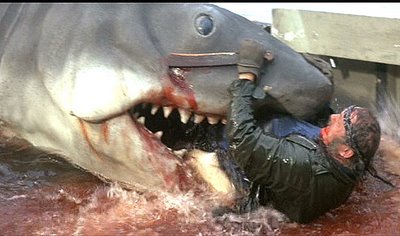
jaws

A shark prop supposed to be a great white reduces the settler population by one. Screencap from Jaws (1975)

Instead of shark attack cinema reproducing anti-black normativity through examining every possible story but the true one, it can offer different reference points for meaning. Instead of anti-blackness being the frame through which the story is told, a different positionality can be the frame that breaks The Hold. A black liberation shark attack story does not the revolution make. But each contribution towards ways of meaning not premised upon anti-blackness creates a new potential hegemony, a new lens through which we engage the world and, in that, a partial end to the present world. It also turns upside down existing shark attack cinema, reframing colonizers being “victimized” by sharks as not horror. Sharks, following “the ghost ship of our modern consciousness” are the heroes haunting the settlers. I don’t want to overstate the potential individual enterprises like what a single shark attack movie against The Hold could do. But it’s hard to imagine action for real change without talking about things. And cinema is one form of conversation. And the nature horror genre can be part of that conversation when it stops giving us every possible story but the true one. Thanks for reading.

Works providing the basis for this essay

Saidiya Hartman Scenes of Subjection

Saidiya Hartman & Frank Wilderson “The Position of the Unthought”

Frank Wilderson Red, White and Black

Fred Moten Stolen Life

Jared Sexton “Unbearable Blackness”

Christina Sharpe In the Wake

Marcus Rediker “History from below the water line: Sharks and the Atlantic slave trade”

Val Plumwood “On Being Prey”

Thanos as Malthus

KINDA SORTA SPOILERS FOR AVENGERS: INFINITY WAR FOLLOW


The new blockbuster hit Avengers: Infinity War has as it’s major plot conflict an attempt by the Avengers, Guardians of the Galaxy and others to prevent the Titan Thanos from collecting all six of the Infinity Stones, mounting them in the gauntlet and using the collected power to end half of all life in the universe. I read this as Thanos taking a very specifically Malthusian anti-demos approach.

Thanos, in the film, is motivated by events from his home moon of Titan where a crisis of resource exploitation came about (the how is not clear). Thanos offer a solution of reducing the potential pool of exploiters but was rejected. Implied in the film is that the continuation of the overexploitation makes Titan a lifeless, desert world in the end.

This is the current trajectory of Earth in the material world, though this isn’t generally explored in the Marvel Cinematic Universe (MCU) that Infinity War is part of. So using Earth as an example, apart from the local geographies were humans first evolved, when humans first arrived in a new geography they exterminated through overhunting or elimination of competitors some of the other megafauna. But this isn’t the same as ecosystem collapse. As example, after humans first arrived on Turtle Island they killed (or otherwise rendered extinct) several large animals but attained a sort of harmony over time by and large. This is the same path that happened in Australia and elsewhere. Capitalism created the overexploitation when it reimagined the ecology not as a place of being but as an exploitable resource. Infinity War naturalizes capitalist this growth-by-any-means throughout the universe as though the “Infinity War” is caused by a class one brought by the capitalist enclosure of the universe.

But in the material world it is capitalist accumulation that produces environmental collapse and resource scarcity. The overwhelming majority of the population, largely delineated by the lines created by colonialism and African Slavery, not only has nothing to do with the cause of the overexploitation, but are similarly victimized by it. Thanos’s understanding is not this though. His is a very capitalist interpretation of demographic danger as if the very fact of population produces danger. Thanos imagines overpopulation as a thing since overproduction and overconsumption cannot be imagined inside capitalism as capital is incapable of self-reflection. His solution then, is to end half of all life to bring “balance” to the universe. Were Thanos focused on overconsumption instead of overpopulation, he would find solutions to the “problem” short of culling the herd.

For example, if the full Infinity Gauntlet can end all life through physical erasure, it certainly could create matter too and produce what is lacked. Or instead of “half”, Thanos could use it to kill the exploiters, the CEOs and what have you. But Thanos can’t imagine this. Instead he designs that half the beings in the universe must die to avoid the fate of his home world. The culling is very much a Malthusian solution of cruel social engineering. The filmmakers give Thanos the libertarian gloss of fake egalitarianism by insisting all the powerful and disimpowered alike will face this culling. But what does this have to do with consumption of resources? If capitalist overconsumption is the norm throughout the MCU then a numerically small percentage of each planet’s population controls the resources. Thanos’ numerically random cull will disproportionately affect the majority, again delineated by the lines of colonialism and African slavery, who are not responsible for this overconsumption, further concentrating power in the hands of the elites who brought on the crisis.

Thanos’s solution is not the only evidence of his Malthusian demographic take. The definition of “life” as exemplified by the cull points to this as well. We see part of the cull in a lush Wakandan forest but no trees or other plants are seen to die, only humans and humanoid-ish beings. So if the definition isn’t literally “life”, then it is some kind of colonial definition of animality that picks what/who is a qualified life and who/what is an exploitable resource less-than-life (which should’ve but didn’t spare a specific Avenger so Thanos must not have read Wynter and Wilderson lol!). Taken as the product of MCU storylines to date, a Malthusian “positive” effect the film describes as inevitable. In one of the concluding lines, Benedryl Slumberpatch’s character appears to be recruited to Thanos’ POV, suggesting an inevitability to the Malthusian culling.

All this is well and good but if Thanos is Malthus, what potential does that open up for the Avengers? It’s kinda silly to imagine that Tony Stark is anything but an arms dealer and Steve Rodgers is anything but an imperial super-grunt but being forced to take an anti-Malthusian position allows for the possibility of anti-colonial positioning. Expecting this from the MCU is silly but it’s something to aspire towards.

Casting a Spell of Settler Normativity

doctor_strange_ver2

The 2016 film Dr. Strange is a paradigmatic example of how the settler society naturalizes settler colonialism in the imaginary universes it produces. The film studiously avoids political discussion so the coloniality is only implied, albeit quite heavily. Folks who followed Dr. Strange’s production will remember problems in the film’s production related to both the orientalist narrative and whitewashing of the cast . But this is not where the film’s racism ends. As noted previously on this blog, the US settler society produces imaginary universes that share it’s premise of indigenous removal. The Marvel universe is no different than the material universe in this regard. The United States destroys the native world through constructing the anti-Black one.

We learn towards the end of Dr. Strange that there are three “sanctums” operated by the Masters of the Mystic Arts. One is in Hong Kong and the second in London. Neither of these are obvious historical choices for a mythology supposedly stemming from the Tibetan plateau. But both have had human populations for several thousand years. So let’s chalk it up to drift. The third is in New York City. Why should this be? Why would this ancient sect set up shop in such a young city? How long has it been there? Were/are the sorcerers settlers? Did native Masters of the Mystic Arts prior to European colonization operate the sanctum? No matter how we answer these questions they exemplify settler normativity, how the destruction of the native world and construction of the anti-Black one is naturalized in settler discourse.

If the Masters of the Mystic Arts set up the sanctum as part of colonization then “defending the planet” from extradimensional threats means defending the settler’s world, defending a colonial cosmology; the destruction of the native cosmos is already including in their very settlerness. If they were there before colonization, why did they not defend the native cosmos from settler invasion? From what little we’ve seen there is no question of ability. Through making portals they could’ve simply rerouted ships back towards their own lands or to Antarctica or beneath the ocean surface, all that before considering their superiority in potential violence. Dr. Strange’s cosmos explores neither of these because it cannot. To explore either one is to question the premise of the settler cosmos. Instead it goes unasked. Like all basic questions of settler colonialism, it is simply naturalized in discourse at a level below the observable because it is the frame through which observations are made. The comics offer a little more information on this but it’s really more of the same, naturalizing indigenous removal in the narrative as a natural progression from native to settler. The dispossession of natives is as fundamental to settler imaginary universes, including the settler fantastic, as it is to the material settler colony. This also shows yet again the limits of improved representation alone. The question of settler normativity is structural, not representative and basic changes to the Marvel universe are required to address this spell of settler normativity.

From Abar to Black Panther: Witnessing the superheroism of Black storytelling

Guest post from Briana Ureña Ravelo.


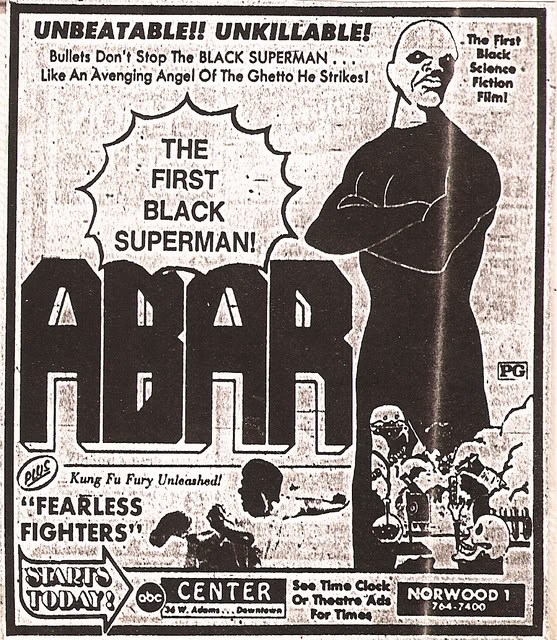
Abar broadsheet

Broadsheet for Abar: The First Black Superman

To gear up for my Black Panther weekend starting today, I have been watching movies from the Marvel Comics Universe and the movie Abar: The First Black Superman (rereleased on video in 1990 as In Your Face), a 1977 Blaxploitation film credited as the first Black superhero movie. It is the story of a young poor Black organizer, Abar, part of a Black Panthers-reminiscent group of hip young militants called the Black Front of Unity, and an affluent Doctor Kinkade, on the brink of a secret scientific development, and his family newly located to a white neighborhood not to happy about the prospect of a Black family moving in. In fact, one woman, furious at the prospect of the illusion of a pure white community being destroyed, explodes and threatens the family with arson, assault and mobilization of the community against them.

Now to be sure, it is a low-budget Blaxploitation film of the corniest kind. In this review I won’t be touching upon the technicality or quality of the acting, writing, plot or action, because honestly it would end there, it’s all so embarrassingly shoddy and amateurish. Granted, there are moments wherein the poor quality adds to the comedic or narrative affect. One such moment is when the titular character Abar literally rides in on the side of a garbage truck to Dr. Kinkade’s rescue while funky 70s action music plays in the background, fights two white men who are assaulting Dr, Kinkade and throws them in the garbage, enlisting his garbage truck driving-accomplices to clean up the Kinkades’ yard and throws the trash on top of the discarded men, one of whom’s leg is sticking akimbo.

BFU

The Black Front of Unity arriving to take out the white trash

The dialogue, however bad it is, also yet has many gems. One is a conversation between Abar and Dr. Kinkade wherein Abar castigates Kinkade for being affluent, bourgeoisie and white-aspiring, accusing him of no longer caring for the poor Black people he comes from and that Abar fights for. Dr. Kinkade dismisses him and his “ghetto-preaching” and says he thinks change comes from the Black voting block. Abar then says that actually doesn’t do much to achieve change because it doesn’t guarantee good politicians of any background and the ones in office currently, Black and white, weren’t changing anything. Why would the more do it? Essentially, Abar was telling Dr. Kinkade to shove his liberal sensibilities up his ass, wake up and see the desperation felt in the hoods Kinkade wished to avoid for the sake of upward mobility and, instead, use his affluence to help and move back to the hood.

The film is filled with many such class critiques of the position that Dr. Kinkade and others like him have as an affluent Black people and their clear disgust and disdain for poor and working class Black people, their affluence named by Abar and others in his crew as being stolen from poor Black folks. Dr. Kinkade is painted as a traitor to other more marginalized ghetto folks, albeit a sympathetic one only trying to do what’s best for his family and help Black people in the long run. Narratives of Black sacrifice and and martyrdom abound and dance between honest tellings and Black pain porn.

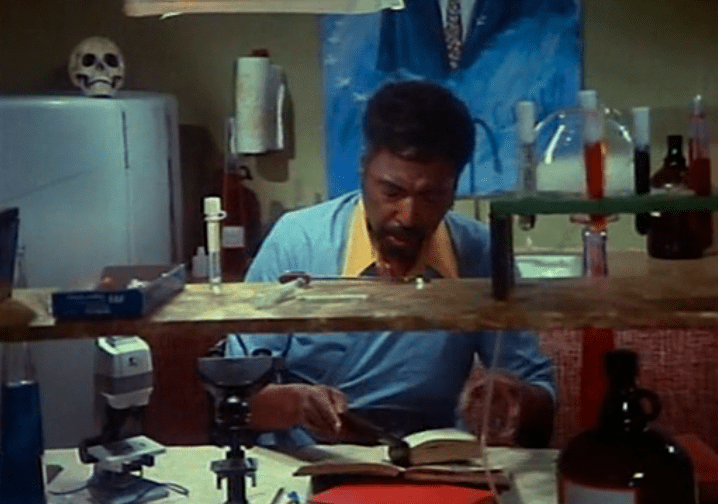
kinkade in the lab

Dr. Kinkade in the lab looking for the missing piece needed for his superhero potion

An Afrofuturistic showcasing of scientific advancement as the key to lead Black people to a brighter liberated future lies in Dr. Kinkade’s experimentations that lead Abar to develop super powers and fight the ills that plague the Black community. Dr. Kinkade and Abar fight amongst each other and within themselves about tactics and perspectives and sacrifice. Does acting respectable, obeying the law and voting for change work best? Or does the impoverished demanding freedom and taking justice in their own hands from the bottom down by any means necessary lead to true change? Dr Kinkade’s lab has a poster of Martin Luther King, Jr. looming in the back and he and Abar have multiple conversations and exchanges about his method and legacy and their thoughts and struggles with it. Abar names that he doesn’t want to be a supernatural hero, perfect. He just wants suffering to stop but to still be flawed, passionate, human.

The white neighbors are apathetic and sneering at best and overtly racist, abusive, murderous (seriously they all have guns and bombs and try their best to take this family out and succeed in killing Doctor Kinkade’s son), self-interested, cruel. The politicians, including the Black ones, want no trouble and clearly lay out a plan to use the law and pay-offs to strong arm the family out. Police murder then plant a gun on black man they shot without reason.

Abar and Kinkade, before Abar's suit wearing stars

Abar and Dr. Kinkade before Abar starts wearing suits

At the end of the movie after he discovers Dr. Kinkade’s experimentations and drinks the potion that makes him superman, Abar, who was the cool militant voice of the film, strangely enough becomes a Black Respectability Politicking Jiminy Cricket in a suit with the ability to walk around and hypnotize dark skin poor Black people to stop pimping, partying, gambling, gangbanging, drinking and robbing each other. Even though he spent the whole moving decrying the respectability of Dr. Kinkade, he inevitably becomes an image of respectability himself. He does at one point magic away a clearly wordly pastor’s fancy car away and instead make him ride a horse and buggy, and turn the fancy meals of upper class Black people belittling the state of poor Black people into maggots and worms. There’s many moments where the story is super sympathetic towards the wildly savage and violent white people constantly attacking the Black characters, but Abar and his militancy shines through at the end when he enacts Exodus-style vengeance on the racist white people of the town via plagues.

It’s cliche, but infuriating to say that it shows that not much has changed, both in the frustration that is still facing the same challenges Black people over 40 years ago faced but also in really powerful and rooting sense that we are still telling and navigating Blackness, oppression, and heroism in the face of it through media. Overall, I was struck at how many parallels, good, bad and complicated, that could be made between this movie and existing depictions and narratives in Black media today, and in political struggles of this day as well.

Aside from just good ol’ blatant racism, part of the reticence from white people towards Black superheroes and storylines is racialized anti-Black perceptions of Blackness as burdensome. That is, Blackness does not easily allow anyone, Black, white or otherwise, one to fully escape and suspend belief to immerse oneself in an alternate universe that doesn’t in that universe deal and touch upon the realities of Blackness in one way or another. Whiteness, socialized as the default blank slate, can escape all definitions and under white supremacy fully embody everyone. In tandem it does not believe Blackness can be relatable to anyone who isn’t Black nor allow Black people to abandon the constraints of this world to experience and immerse themselves in comic book and movie world either. You have to, in one way or another, face, embrace, illustrate, grapple or full on put paint the town red with Blackness if you feature Black people in your story line. Abar does it poorly and heavy-handedly, with many missteps along the way, but there are still really good moments that feel current and relatable because it is dealing with Blackness in a superhero film where the problem is oppression and the supernatural element’s goal is to liberate Black people.

It shows that this alleged narrative burden of Blackness — of always being perceived through that lens — is not alleviated by trying to shirk it and be “colorblind”. Instead, by rejecting the notion that it is a burden in the first place, and embracing Black history and narrative traditions and using them creatively in a superhero film, it expands other people’s racist narrow scope of what Black storytelling can look like in that genre while rejecting Eurocentrism and “apolitical” whiteness as the norm. If being “colorblind” and assimilating doesn’t work as political, social and cultural policy why would it work on a narrative level? Abar deals with the realities of Black life and politics in the late seventies while playing the golem. Dr Kinkade, broken by overwork and the loss of his family, reflects and broods quietly with Abar on his porch about Martin Luther King, Jr. and his fear for their people. He says that while nonviolence is a noble goal, a “strong positive force” is needed to “counteract the evil of violence.” That strong positive force is his superman concoction he convinces Abar to drink and use for the good of his people.

And so our best media-literature, comics and film-has always worked to exemplify and describe, elevate and illuminate, grapple and claim, what and how to handle and depict Blackness, the Black experience and Black people. Do you talk about Black struggles and risk only showcasing torture porn stories of suffering, poverty, exploitation, rape, slavery, gang violence and drugs, or do you try to dance around it or skip it entire and accidentally fall into white-washing and sanitizing the Black experience? Do you tell white/European stories but with Black people in them (Idris as Heimdall in Thor) or do you actually try to depict and showcase a Black/African story? Should a white person write and direct that or should they always be Black? How do you do all of this creatively while dealing with real life pushback and racism towards your artistic choices?

I’m excited for Black Panther as it has established the goal to meet these challenge head on by being as Black as possible with as many hands on deck to tell those stories well and with complexity and power. While it is still a major movie in a white industry and a white comic book universe written by a white man (and debuting just before the Black Panther party did), many Black Panther comic runs have been in its more recently history have been written by Black writers, the director and screenplay writer of the movie are Black, and most of it’s cast is Black, unambiguously so. The soundtrack, designs, inspirations, politics are all very intentionally Black and decolonial.

Again, aside from the fact that it is technically poor film, Abar falls flat in many ways, like in its depictions of how to challenge and face white supremacy, oppression and exploitation, medical experimentation and and consent/autonomy, the typical misogynoirist erasure and usage of Black women and girls as objects in a larger storyline dominated yet by men, classism and respectability. I’ll be looking out for these same things and more when I see Black Panther. But the industry, political landscape and discourse has progressed and grown and changed a lot since Abar first was made and came out. Movies like Black Panther and Thor: Ragnarok follow in a much more current manifestation of the tradition that centers Black struggle, culture realities in an alternative universe so as to both give an Afrocentric spin to popular and beloved mediums, archetypes and stories and also to tell decolonial tales with a futuristic edge that showcases powerful and illustrious worlds that are not empty of Blackness but full of it as examples for us in the real world. We use these pieces of fiction to describe, reveal, tell and connect with our true selves, display what our deepest struggles, loves, and desires and lead us as people into more brilliant and creative futures. So as a lover of stories, an organizer and an Afro-Latina woman, I can’t wait to see what Black Panther has in store for us.


The Punisher (1989)

I firmly believe that bad films cannot be made worse for spoilers but what follows reveals some plot points. This is part of a series looking at films from Marvel comics in the run-up to the release of Ryan Coogler’s The Black Panther.

One of the first films based on Marvel comics was the 1989 direct-to-video Punisher adaptation directed by Mark Goldblatt. Dolph Lundgren is Frank Castle with Jeroen Krabbé and Kim Miyori the main villains who are at odds both with each other and Castle (The Punisher). Miyori plays Lady Tanaka, the head of a yakuza organization taking over New York organized crime at the expense of the Italian families led by Gianni Franco (Krabbé). All the while Castle is being sought by his ex-partner and cop Jake Berkowitz (Lou Gossett Jr.).

Franco has returned to New York after the Punisher killed the other family leaders, leaving the mafia in a weakened state. Tanaka takes advantage of this and makes a power play by kidnapping all the mafioso’s children and then killing the parents when they arrive to negotiate a ransom. The cast of killers in that scene is quite funny. Franco forms a tentative alliance with the Punisher in order to save the children. They win the day in the end before Franco turns on Castle and tries to kill him and ends up dead. Solid performances by Gossett Jr. and Krabbé are undermined by Lundgren as Castle. He is at his least charismatic here, seems bored more than stone-faced, and has a bad stubble make-up.

bored doplh

Dolph Lundgren with fake stubble looking more dead bored than dead-eyed killer

Some folks immersed in or brought up in the Model Minority racist paradigm won’t remember so clearly the really intense Buy America campaigns of the late 1970s through early 1990s that peaked with Reaganite White Nationalism. They were not only “Buy America” but especially “Don’t buy Japan”. Much of this was centered around the auto industry and much of it had implicitly or explicitly racist themes, imagery and language. One  famous example is Gung Ho, the 1986 Ron Howard film where a Japanese firm buys a US auto plant. The new bosses constantly yell at the workers in the way the US writers imagined they did at Japanese plants (which, without apologizing for Japan’s poor labor conditions, was and is not the case). There is an intended feel-good element to the film, that strand of U.S. liberalism that is simultaneously racist and anti-union under the guise of “can’t we all just get along?”. A second type of 1980s anti-Asian racism was the Rambo: First Blood Part II and Missing In Action type where Vietnamese people held and tortured U.S. POWs for a decade after Vietnam’s victory and it was up to Americans with machine guns to save them by slaughtering Vietnamese people by the hundreds.

Only American pluck can save the Japanese from overwork

The Punisher‘s plotline has to be contextualized in these popular conceptions. Because Lady Tanaka did not just kidnap the mafioso’s kids, she planned to sell them into slavery which was a key part of their criminal enterprise. “White slavery” was a popular storyline from the 1910s-1950s especially with Chinese and Japanese villains selling white women in pulps, dime store novels and films. The sexual threat posed by Asian men was an important component of “Yellow Peril” discourse, of which this film is very much a part. Asian “white slavery” rings weren’t invented just for this film, they are long a component of the white imagination (and not without crossover into conceptions of “human trafficking” by the way). Just a few years before The Punisher, Girls of the White Orchid, a made for tv movie starring Jennifer Jason Leigh, offered a feature length story on American television of an innocent white girl tricked into sex slavery by the yakuza. A more recent version is the 2008 film Taken where Liam Neesen must save his daughter from evil Arabs who buy her as a sex slave. Best I know, none of these narratives meaningfully looked at actual Japanese kidnapping of Korean women during Japan’s colonial rule there.

Lady Tanaka laughing evily

In the final scene Tanaka is for no clear reason wearing something like geisha make-up and costume, presumably to play up her alterity. Furthering this otherness, most of the yakuza killed during the final scene are men wielding swords while dressed in hakamas because….yakuza bring swords to gunfights I guess. Ya know, just because they’re organized crime doesn’t mean their crime is well organized! For context on this, Punisher is a hardcore fanatic. See as one example the page below from the Civil War storyline. Punisher has sided with Captain America against Iron Man and the government. Some supervillains have thrown in with Cap too, understanding the threat posed by the Registration Act that would add yet another felony charge to their everyday activities, this one for simply existing without registering their powers. When they reveal themselves Punisher immediately mows them down. When Cap flips out about this, Punisher says “they were killers and thieves”. In most iterations Punisher has no grey zone. So in the 1989 film it takes something really extraordinary for Castle to be working with Franco. That something is Japanese otherness.

Production wise this isn’t the worst Punisher film but, in close competition with the 2011 short film The Punisher: Dirty Laundry, is probably the most racist. This is the Marvel world into which in 47 days comes Ryan Coogler’s Black Panther. I wanna keep focus on that last sentence to contextualize how much work it will have taken to pull off a Black liberation vision within Marvel, if that is what Coogler’s film turns out to be.

The anti-blackness of interracial porn

Thanks to Adrenalynn and Zoé Samudzi for feedback on the draft in clarifying ideas, correcting misconceptions, identifying missing elements and improving writing. Their contributions in no way make the following their fault. After finishing this draft a friend put me on to Mirielle Miller-Young’s book A Taste for Brown Sugar: Black Women in Pornography. After quickly rifling through it seems to cover parts of what follows if from a different angle. It came recommended and I pass along the recommendation here for people looking for an in depth treatment of some of what follows, specifically the parts dealing with black women. Special thanks to Jared Sexton for their text Amalgamation Schemes.

The term “interracial porn” seems a little sketchy on the face of it. But what exactly is going on with the marketing and labor practices of interracial porn? An examination finds fundamental problems, specifically a baseline anti-blackness. Here I lean heavily on Jared Sexton’s analysis in Amalgamation Schemes and, guided by numerous performers who have made public criticisms of interracial porn as a concept, read interracial porn marketing through Sexton’s analysis of miscegenation/antimiscegenation discourse. As per the industry, performers and consumers, I identify interracial porn as scenes between black men and white women. Interracial porn represents both an aspect of miscegenation/antimiscegenation as well as its deployment for purposes of capital accumulation. Tracing the history of this discourse illuminates interracial porn’s ethical problems.

“Race” and “Interracial”

“Interracial” necessitates a pre-existing “race” so we’ll start there. The late Patrick Wolfe writes of anti-black racism, “Though born of slavery, […] race came into its own with slavery’s abolition. So long as slavery persisted, race – for all its usefulness as a justification – was relatively redundant as mode of domination.” This rise of race, which is the same as saying the rise of racism, “means that the boundary that had previously separated a Free Black from a slave disappears, which is to say that, in place of the slaves, a new and more inclusive oppressed category emerges. […] In other words, emancipation cancelled out the exemption: you can be an ex-slave, but you can’t be ex-Black.”

Affirming the boundary of the newly unified black racialization was achieved in large part through sexual politics. Democratic Party supporters from the New York World newspaper coined the term “miscegenation” (from Latin, ‘group mixing’) in 1863 in an anonymous pamphlet intended to sway the 1864 elections in favor of the Democrats. The pamphlet, titled Miscegenation: The Theory of the Blending of the Races, Applied to the American White Man and Negro, claimed a Republican Party goal of intermarriage between white and black populations. While there was a debate amongst white people on whether or not to continue African Slavery, there was consensus against intermarriage and the newly popularized term miscegenation. This is to say that the concept of “miscegenation” is a product of a preexisting antimiscegenation (this also is an example of white supremacy being a manipulative power tool between groups of powerful white people more than between groups of white people with and without power as per the popular “split working class” theory of racism.). As examined further below, this applied/s to white women with black men. White men with black women, primarily via rape – consensual sex between enslaver and enslaved is impossible – was an accepted if unmentioned practice. Miscegenation/antimiscegenation is fundamental to biological racism and is inherently gendered, focusing as it does on reproduction and sexual encounters. Post-slavery (“post”…), miscegenation eventually becomes the sexual political concept today discussed as ‘interracial,’ the change stemming from the shift from explicit white nationalism to white nationalism under the guise of multiculturalism.

Jared Sexton writes on antimiscegenation and gets to the crux of interracial porn’s racist politics.

“If white racial identity has a public reputation as a form of purity, then antimiscegenation is the mode of production for the value of whiteness. […] However, antimiscegenation is not the essence of white supremacy or antiblackness. Rather, white supremacy and antiblackness are fundamentally relational processes unfolding between antimiscegenation and its necessary failure. White supremacy and antiblackness, in other words, emerge in the interplay between miscegenation and the forms of resistance to it. An important claim follows from this reasoning: rather than establishing themselves in vulgar opposition to miscegenation, white supremacy and antiblackness produce miscegenation as a precious renewable resource, a necessary threat against which they are constructed, a loyal opposition, a double exposure. They rely upon miscegenation to reproduce their social relations; their relations are, in fact, this very reproduction.

Miscegenation is thus taken to indicate processes of mixing, meddling, or mingling between the general and the particular, between the ephemeral body of white universality and the strangely dense corporeality of its dark-skinned others, imagined as a sprawling and overpresent, anonymous in their racialized particularity. […] Antimiscegenation is not a convenient rationalization for some other instrumentality; it is a vital component of the creation of race ex nihilo, a social contraction articulated as the form of white identity.

Sexton sums up noting that “miscegenation is a name for the imperceptible productivity of white supremacy and antiblackness.”

Miscegenation/antimiscegenation’s “mixing, meddling or mingling” describes black as a contaminant, the contaminating element being slavery. One version of this is, in Wolfe’s phrasing, “the fact that the paternity of black women’s children continued to have no effect on their status which remained rigorously matrilineal.” Enslaved mothers gave birth to slave babies no matter the father’s status. Per Barbara Fields, U.S. society and law “considers a white woman capable of giving birth to a black child but denies that a black woman can give birth to a white child.” This is African Slavery’s racialization where enslaved women were (re)producers of property and commodities through childbirth. Wolfe continues, “Thus black women are not only barred from having white children. Along with black men, they are barred from having any children other than black ones.” Here white women are inherently violable and in need of constant guarding of their fragile purity, and black women inviolable and ever receiving. By “inviolable” I do not mean “protected,” but that there is nothing that can be done that will be considered a violation. Nothing done to black women will be termed harm. In Saidiya Hartman’s words, “No crime can occur because the slave statutes recognize no such crime.”

Anti-Black Pornography

Skin Diamond notes that, “Interracial is only ‘interracial’ if it involves a black man and a white girl.” Sexton concurs writing, “to be considered interracial, especially in the U.S. context, [a relationship] must involve a black person. This is not always the case, of course, and there are myriad historical examples of hysteria prompted by the prospect of sexual encounter between whites and nonblack people of color. What I sense, however, is that within the racist imagination, relationships with blacks, whether the other is white or a nonblack person of color, constitute interracial relationships par excellence.”

Diamond continues, “Technically, most of my porn is interracial but because I’m a black chick, it doesn’t count. People only wanna see the taboo of a black man with a white girl.” Diamond’s analysis of her scenes with white or other non-black men ‘not counting’ speaks again to the inviolability of black women and has two meanings. “It doesn’t count” in both marketing and accounting. This plays out in different earning potential for white and black women performers.

The higher earning potential happens in two ways. White women performers, especially successful ones, often follow a progression of roles. Lexington Steele describes it, “There are situations where it could be the industry, whether it’s her boyfriend, her husband or management that suggests she either doesn’t do [interracial] at all, or waits until a certain time when her rates can appreciate over time. Where it’s: girl-girl to boy-girl to anal to DP [double penetration] to, and then the ultimate she can charge her most is when she finally does interracial.” This is career path is unavailable to black women performers whose scenes are always already “racial” but never “inter” from an earning perspective, even when explicitly pointed out as such. For example Nyomi Banxxx recalled about a scene with a white male performer, “I had this conversation with my agent. I had this conversation with a director, because we were arguing about rate. I said, ‘I need to get paid for an interracial rate, IR.’ ‘No that’s not IR.’” This is one reason why Misty Stone says, black performers “do the same amount of work but [white performers] get different opportunities.”

Another aspect of higher earning potential for white women is some performers (or their managers or agencies) simply charge more to do scenes with black men, which is the same as saying they are racist. This is not universal and some producers, not to mention many white women performers, actively protest this specifically because it is so viscerally racist Unfortunately much of this resistance is articulated with demands to do interracial porn, to enact “the imperceptible productivity of white supremacy and antiblackness.” It is not asking white people to place their bodies in the way of racism, but to use them to (re)produce it. Further, it polices white women’s bodies to perform an ‘I’m not racist I fuck black men’ action which proves exactly nothing.

Both the higher rate via career progression and higher interracial rate effectively place a ‘hazard pay’ rate or ‘burden tax’ on doing scenes with black men. In other words, interracial porn labor schemes say ‘black dick comes at a price’ and that price will be paid to white performers. It goes without saying, though needs saying, that black women performers get no such ‘hazard pay’ for doing scenes with black men because the perceived contaminant, the reason for miscegenation/antimiscegenation discourse and higher rates for white women performers, cannot affect black women who are inviolable and already ‘Blacked’ as per the next section.

Black the Verb

This idea of the “one-drop rule” whereby any black ancestry produces a black positioning is the basis of miscegenation discourse and the fetish of interracial porn. The interracial porn website Blacked.com illuminates this. The name, Blacked, invokes blackness as a corruption, as an action. ‘Blacked’ is not sex between equals, it is something that is done to someone, specifically to white women. It is white purity that is being ‘Blacked’. ‘You, white woman, have been Blacked’. There are numerous other examples like the 2012 Vivid title, Allie Haze’s Been Blackmaled. Sex with black men is “blackmaling”.

The public, especially though not exclusively the white public, approaches interracial porn with miscegenation/antimiscegenation enacting “the imperceptible productivity of white supremacy and antiblackness.” The Twitter mentions of popular white porn actresses are filled with demands for and condemnations of interracial scenes (search at your own risk and with plenty of sage to burn). Those condemning treat interracial porn as violations of white purity and clarify what ‘Blacked’ actually means in practice. The number of scenes and films with ‘cuckhold/cuck’ storylines is part of black as a contamination, as a corrupting element. This weaponizes both black penises and masculinity while giving logic to the laser focus on black penises, colloquialized in interracial porn lingo as “BBC” (Big Black Cock). The motivations of those demanding interracial scenes are less clear. It appears to be a mix of demands to see black male representation with popular performers and fetishization of the interracial encounter, often both.

The ‘blacking’ racialization follows black men performers. Whereas black women performers are inviolable, black men performers are always violating, except in scenes with black women. Black men’s scenes are always already racialized. As Sexton notes, “The presence of Asian or Latino actors (nearly all of whom would be paired with white actors) would either leave the racial designation unchanged or move it into an ethno-specific label, such as Asian, Oriental, Hispanic, Spanish, Latin. Black films, in contrast, were those that starred only blacks.” Thus black men can generally not do ‘normal’ porn except when combined with white men in scenes or films; they can only do black or interracial. ‘Normal’ here means ‘white normative’. Yet, as ever under white supremacy, the ‘white’ is silent or, better put, unenunciated but clearly demonstrated. Thus scenes and films with exclusively black performers are labeled “ebony/chocolate/black” and scenes and films with exclusively white performers are not labeled “white/aryan/snowblind.” This turns into disparate earning potential between black and white men performers. Steele notes that “There is a differential between what I can accumulate versus someone else who is able to work with 100% of the talent pool.” Here he refers to the industry denying him normative white scenes and films as well as scenes with those performers who refuse work with black men. With black women and men performers the divergent earning potential compared to white colleagues is not simply the discriminatory pay rates common to racial capitalism, but a separate, racialized job profile. They are very nearly doing a different job altogether.

End “Interracial”

The problem of anti-blackness is fundamental to interracial porn. Interracial porn is a present day articulation of miscegenation/antimiscegenation. Anti-blackness is evident in the discursive fetishization of blackness, the exploitation of (anti)blackness for capital accumulation by porn companies and the divergent earning potential of white and black performers. It cannot be fixed as its very premise is the problem. Ending interracial porn is not the same thing as ending scenes with black men and white women. The encounter between black men performers and white women performers is not the anti-blackness; the use of the encounter is the anti-blackness. To repeat Sexton, “white supremacy and antiblackness produce miscegenation.” White supremacy and anti-blackness produce this “precious renewable resource” by turning specific porn performances into miscegenation/antimiscegenation, something “Blacked,” interracial. Interracial porn is the use of the racialized encounter as a means to accumulate profits. It continues from earlier regimes the idea of blackness not as an identity but as a “position of accumulation and fungibility.” There is no way to reform it. Ending interracial porn is not the same as hiding or avoiding racism. Performers and companies could still make audience-specific films but it is indefensible that profits are being made selling anti-blackness.

Die Shark! Die!

Thanks to Noah Berlatsky for a much improved title!


Jaume Coller-Serra’s new film The Shallows follows Blake Lively in a test of wills against a great white shark. Apart from an unintentionally farcical and groan-inducing last act, it’s a pretty well shot and acted story. It is one of countless stories about wild beasts threatening the lives of humans. Most of these are, from a statistical or scientific perspective, no less ridiculous than The Shallows‘ silly conclusion. These stories almost always involve absurd science. And towards what end that bad science is deployed tells us a lot, as does the selection of which killer animals are portrayed.

In The Shallows Blake Lively’s character is out surfing when she happens upon a whale carcass. A shark near the carcass sees her as a potential meal and decides to have a bite to eat. Over the next day the shark ignores the massive quantity of food available with the whale carcass while stalking Lively, and during that time eats two and a half other people.

All this is exceedingly unlikely. The shark ate somewhere around 200kg of people over those two days which is, using the most conservative estimates, around two months of food for an adult great white (other studies suggest this is closer to six months worth of soylent green). So the shark ignores (or leaves, it’s not clear) a massive whale carcass which could feed a host of sharks for months and instead goes after a bunch of swimmers and surfers that don’t have the yummy (for sharks) smell of rotting meat. And it does so in order to overeat by quite a bit! For contrast in the infamous 1916 New Jersey shark attacks a shark ate a maximum of .3 people over twelve days (though it killed four).

This is common in these kinds of stories. For example the T-Rex in Jurassic Park should be done eating after she eats the company stooge. That’s (probably) enough calories for a T-Rex for two days. That it keeps hunting seems pretty unlikely. The shark in Jaws eats even more beyond its likely diet. And it is exactly this voraciousness that identifies the creatures as antagonists in these stories.

There is a species power dynamic in play obscured by this. My back of the envelope math says humans comprise about .0000042% of deaths in fatal human-shark encounters. No big surprise here. It’s common enough knowledge that humans kill exponentially more sharks than the other way around. And given the challenge in imagining a shark’s point of view, it isn’t all that surprising that humans with almost no exceptions tell the stories of those .0000042% of fatalities rather than the 99.9999958% percent of them. Sure, the Discovery Channel trots out the annual shark slaughter statistics during “Shark Week” but they’re invariably mixed with stories of shark attacks lending a false narrative symmetry even as the statistical symmetry is denied. Man-eating bear, wolf, lion, snake and other such stories all follow this same pattern.

This is how power generally works, both between our species and others and inside our own species. The oppressive relationship is inverted no matter what the science says. So despite all populations using and selling drugs at nearly identical rates, it is Black people who are portrayed as the drug-dealing criminals thus positioning them not as victims of racist mass incarceration, but as justifications for the oppressive system. Despite Israel dispossessing Palestinians on a daily basic, it is Palestinians that are portrayed as the violent aggressors, much as natives are commonly portrayed in US Western stories. The dynamic is analogous to how the tv show Zoo tells of a worldwide animal revolt that threatens humanity while we are in the midst of an anthropocene/capitalocene mass extinction event. The bad science of insatiable predators is deployed justifies the bad practice of exterminating them.

The inter- and intra-species analogies are, of course, imperfect even as the racist narratives invoke a certain dehumanization and animality. But the racialized component of which killer animal stories are told tells us just as much about inverted narratives of threat and power. For some animals do kill, and even kill and eat, vast numbers of people every year. Blake Lively will likely never star in one of these stories.

Nile crocodiles kill somewhere between several hundred and several thousand people every year in Africa throughout their range. We don’t even have sound estimates because relatively few resources are dedicated to tracking African deaths. Crocodiles eat people on a daily basis because people have to spend so much time in crocodile habitats with minimal protection. Though there is nothing that would end crocodile attacks entirely, this largely isn’t a problem of reptilian predation , this is a problem of capitalism and colonialism. The stories told of crocodiles eating humans are instead like Lake Placid, a fun film that is science fiction both because of the vast numbers of people consumed and because of which people are consumed. Out of some three dozens feature lengths films about killer crocodiles and alligators, I know of only one that takes place in Africa, 2006’s Primeval, a racist story of white people in constant danger from both Burundians and the crocodile.

Though not eating us, snakes kills tens of thousands of people every year, predominantly in South and Southeast Asia (and to a lesser extent in Africa and parts of South America). These are predominantly tied to poor labor and housing conditions which are, again, a problem of capitalism and colonialism. The Anaconda tetralogy and Snakes on a Plane do not tell these stories.

Dominating both of these are mosquito-related deaths which number in the hundreds of thousands every year despite malaria being, for the most part, easily treatable were resources dedicated to the task.

These killer animal stories are not told on screen because the victims aren’t fully human in the eyes of those choosing what stories get produced. And those stories with fully human victims like The Shallows invariably invert the material world predator-prey relationship. The exceptions are exceedingly rare and even then are told with circumscribed or regressive politics. The Ghost and the Darkness and Prey for example, are pro-colonialism stories of animals preying on humans based upon the man-eating lions of Tsavo. The body count is attributed to lions and not the colonial railroad project (a dam in Prey‘s version) that brought people into the lions’ habitat in the first place. But telling such stories can illuminate vast political economic problems and indicts the systems that produce the death tolls. Capitalism and colonialism continually produce horror stories of animals killing people with body counts beyond all but apocalyptic imaginations. Jaws simply cannot compete.

The Apocalypse’s Apocalypse and Post-Apocalyptic Visions of Sunshine and Blessings

This posts stems from a conversation with Kyle Johnson after we watched Mad Max: Fury Road together. Thanks to Linda Quiquivix , Zoé Samudzi and William Copeland for feedback on the idea and draft to help make it vaguely coherent. In thinking about worlds I leaned heavily on Frantz Fanon’s Wretched of the Earth and Frank Wilderson’s Red, White and Black even where not cited directly. None of the above can be blamed for what follows. After completing the draft a couple of friends put me onto this great recent CBC conversation which also covers parts of what is below. Special thanks to Cass Chen who was a wonderful friend, host and conversationalist while I scribbled.

George Miller’s 2015 film Mad Max: Fury Road takes place in a post-apocalyptic Australia. Like most apocalypse/post-apocalyptic stories Fury Road comments on the present through envisioning a dystopic future. The film opens with news clips framing the violence to follow as descended from resource wars and global warming. Resource extraction and climate change are ready topics for exploring the end of the world and it is no surprise to find them as common topics for apocalyptic storytelling in cinema, novels, television and comic books. In settler colonies these stories comment upon today’s problems while neglecting that another apocalypse, one suffered by the indigenous population, pre-dates the story. Exploring post-apocalyptic storytelling with this in mind challenges settler colonial normativity and further opens up the world’s end to decolonizing visions.

Ending Othered Worlds

Fury Road, Brian K. Vaughn & Pia Guerra’s comic book Y: The Last Man and Robert Rodat’s tv series Falling Skies all offer different causes to the apocalypse. Fury Road is unspecific but points towards ecological destruction through climate change and resource wars. Y: The Last Man‘s apocalypse is an unspecified illness or curse that simultaneously kills all the mammals with a Y chromosome (in an unproduced script, Vaughn lays the blame with a U.S. biological weapons attack on China). Falling Skies‘s end of the world comes from extraterrestrial invasion.

Fury Road further comments on climate change and monopolization of resources as a means of centralizing authoritarian, patriarchal power. It follows a group of people through a mostly empty wasteland as they seek the “green place” while they are hunted by those who control the resources. Y: The Last Man narrates Agent 355 and Dr. Allison Mann as they seek to find a cause and cure for the plague that killed all terrestrial mammals with the Y chromosome but for Yorick Brown and his monkey Ampersand. The authors focus on patriarchy, Israeli militarism and market violence. While it is is a global story, it starts in the United States and most of its key plots points take place in three settler colonies, the United States, Israel and Australia, before departing to Japan and France later on. Falling Skies looks at the Second Massachusetts, an irregular militia comprised of survivors of the extraterrestrial Espheni conquest that killed 90% of Earth’s human population as they seek to overthrow Espheni rule and restore the United States. Falling Skies affirms American exceptionalism, laments how the U.S. strayed from the perceived ideals of early republic and takes a geocentric view of the universe in its firmly conservative critique of the present.

These stories offer three different critiques of the present from three different political views and are produced in three different mediums in two different settler colonies. Yet all are representative of a genre of post-apocalyptic storytelling that does not contemplate that the lost U.S. and Australian societies are premised upon settler genocides against the native populations. The closest any of the three comes and the closest the overwhelming preponderance of the genre come is when Y: The Last Man briefly discusses Israeli civil disobedience against Israeli bulldozing of Palestinian houses as part of developing the Israeli character Alter. One notable exception is Mel Gibson’s film Apocalypto which engages a pending colonial apocalypse only to justify it. Another is District 9 where some references are made yet are mediated by the white South African hero.

Settler colonialism, the establishment of the stories’ lost worlds, is an anti-native apocalypse and, in the United States, Canada, South Africa, Brazil and Rhodesia, also an anti-Black apocalypse. The racializations of Black and native are mostly different but were simultaneously constructed through the same colonizing events. Both are products of settler colonialism. Settler colonialism builds the settler’s world – the anti-Black world – by destroying the native world and does so in a 1:1 ratio. Every acre created of coastal British/American Virginia is one acre less of Powhatan Tsenacommacah. Every dunam of Israel is one less dunam of Palestine. Settler colonialism through eliminating sovereignties and populations and creating regimes of gratuitous violence brings about the end of a world. It is sometimes even named as such as when Palestinians refer to the accelerated 1947-1949 period of Zionist ethnic cleansing and the establishment of the Israeli settler state as the Nakba (‘catastrophe’).

That we settlers comprise an anti-native apocalypse means that all our cultural production is apocalyptic, is the product of an ongoing apocalypse, including post-apocalyptic visions. John Grisham’s The Firm is an apocalyptic novel of legal corruption. Miley Cyrus’ “Wrecking Ball” is an unrequited love anthem of the apocalypse. Strictly Ballroom is a film about apocalyptic cross-cultural and cross-class ballroom dancing and romance. Almost all of Danielle Steel’s opus are apocalyptic love story books. Only Miley Cyrus’ career of those four actually feels like a sign of the apocalypse but all are inherently apocalyptic as products of settler colonialism. What the intended post-apocalyptic stories Fury Road, Y: The Last Man and Falling Skies unknowingly narrate is a prior apocalypse experiencing an apocalypse itself, the apocalypse’s apocalypse. The destruction of the settler colony provides the post-apocalyptic wasteland the protagonists navigate.

Elizabeth Povinelli describes settler normativity as the “organization of sociality on the basis of the naturalness of a civilizational displacement.” Alternately put, anti-native genocide, quashing of native sovereignties and, in some settler colonies, African slavery are the fabrics that weave together and underline all settler colonial discourse and relations. Settler everyday life is the anti-native and anti-Black apocalypse but for we settlers, it is just life. In this read Furiosa and Max are settler revolutionaries fighting Immortan Joe and the settler capitalists over control of stolen Aborigine land and resources. This is why it is unsurprising that Falling Skies and Y: The Last Man both fail to engage the anti-native apocalypse despite making numerous references to the early U.S. republic, a time when even normative settler discourse knows (but always remembers to forget) that Indian Removal programs were aggressively underway in some way, shape or form.

It is hard to imagine dystopic settler stories being otherwise for settler colonialism, like all organizations of power, builds the world it inhabits. In settler colonialism’s world settler colonialism – the anti-native and anti-Black apocalypses – is near impossible to see as it is our very frame of reference. A challenging thing about normativity is it’s paradigm paradox: From what frame of reference can we observe our frame of reference? When settlers imagine the end of the world then, we imagine it as synonymous with the end of the planet or species and not the end of settler colonialism’s world. But stories consciously narrating the apocalypse’s apocalypse could describe the end of that world. They can offer a new frame of reference and play a role in subverting and disrupting settler colonial power and discourse.

The World is Ending! Hooray!

Settler storytellers explore all kinds of fascinating, entertaining and illuminating scenarios to describe the end of the world. The Terminator and The Matrix stories look to the artificial intelligence singularity. Deep Impact ends part of the world with a comet collision. The Walking Dead comic book, tv series and a long-running series of George Romero’s of the Dead films narrate a zombie apocalypse. The Wayward Pines book trilogy and tv series look at apocalypse through divergent evolution and On the Beach‘s apocalypse happens through nuclear war. None of the above reflect on the anti-native and anti-Black apocalypses.

Potentially even non-anthropocentric ones can be told. For example there is Vitamin Z – a yet to be made film documenting the multiyear boon in slow-moving, uncoordinated, easily obtainable, though quite bitey, prey for carnivores and scavengers that follows the zombie apocalypse and restores their populations to pre-capitalist/pre-colonial population levels. I hope Keith David or David Attenborough is available to narrate!

But what about when the end of the world is the apocalypse’s apocalypse? Frank Wilderson notes that, “The Slave needs freedom from the Human race, freedom from the world. The Slave requires gratuitous freedom.” Indeed, settler colonialism’s world of dispossession and gratuitous violence not only can end, but should. Stories of the end of this particular world need not be burnt skies and genocide. In narrating the end of an apocalypse they may well tell the opposite: clean air, vitality and an end to gratuitous violence and suffering. The end of settler colonialism’s world can be sunshine and blessings, little children laughing and singing silly songs, lovers dancing or any other beautiful thing. These are legit post-apocalyptic visions when describing an apocalypse happening to a prior apocalypse when combined with Black and native liberation. So are ones less polarly optimistic or romantic.

The material world stories of the whole or partial end of settler rule in Zimbabwe, Liberia and South Africa are decidedly complicated and frequently tragic. Settler colonialism is not the only wronging world in play as Black feminism’s intersectional resistance teaches. Yet stories consciously telling the apocalypse’s apocalypse can offer a discursive break, a frame of reference separate from settler colonialism’s dispossession and gratuitous violence. As Frantz Fanon wrote, “To break up the colonial world does not mean that after the frontiers have been abolished lines of communication will be set up between the two [colonial and decolonized] zones. The destruction of the colonial world is no more and no less than the abolition of one zone, its burial in the depths of the earth.” Stories telling the end of this world can be part of the shovel.

None of this is to argue that post-apocalyptic and apocalyptic stories cannot be robot apocalypses, nuclear holocausts or extraterrestrial invasions. They are frequently insightful, critical, imaginative and even beautiful. But such visions can still adopt a frame of reference not dependent upon settler colonialism’s dispossession and gratuitous violence and recognize that the anti-native and anti-Black apocalypses have long been happening. In doing so stories of the apocalypse’s apocalypse can obliterate a world that has it coming.

The Interview – Two Deeply Unpleasant Hours of Cinema Paradisbro

The Interview

dir. Evan Goldberg & Seth Rogen
112 min | 2014
Columbia Pictures, L Star Capital, Point Grey Pictures

the-interview-poster1

Evan Goldberg and Seth Rogen’s latest film The Interview was bound to get some attention even before its distributor, Sony, was hacked and the ensuing debacle with alleged threats from North Korea (DPRK). A film this racist would get attention regardless. Unfortunately due to the publicity around the Sony hack many more people will likely be subjected to The Interview and the attention won’t be as negative as it deserves. What follows includes spoilers if you believe something already rotten can be spoiled.

The Interview opens with an othering scene of a young North Korean girl singing about destroying the U.S. before an audience of dignitaries prior to a missile launch. The othering completes with a series of shorts news clips about North Korean ruler Kim Jong-un (Randall Park) being the next Hitler before introducing Dave Skylark (James Franco).

We meet Skylark as a tabloid news host interviewing Eminem in a scene that kicks off nearly incessant gay jokes. Skylark is the kind of guy with no qualms about breaking into caricatured Black Vernacular English as ‘comedy’ nor any idea about why anyone would have such qualms. Pressured by producer Aaron Rapaport (co-director Seth Rogen) to due serious journalism, Skylark comes up with the idea of interviewing Kim Jong-un as a bridge. Rapaport will get serious news and Skylark will get sensational ratings.

Rapaport is the sober foil to Skylark’s unfiltered and hyper stream of consciousness. He’s shamed for his tabloid work by a fellow journalism school grad who now works for 60 Minutes. Rapaport’s sophistication is juxtaposed next to Skylark’s visceral racism and sexism. But they both due caricatured Korean accents. They both immediately ogle Agent Lacey’s (Lizzy Caplan) breasts. They both constantly make gay jokes. While Skylark is the dense one, the juxtaposition between he and Rapaport is one of tone only. So when at the end when Skylark says to a puppy, “Guess who’s going home to America where they don’t eat doggies” and Rapaport doesn’t let him finish he is not disapproving, merely hurrying him along.

Sook (Diane Bang) and the North Koreans are introduced with a soundtrack is only slightly less ominous than Darth Vader’s “Imperial March” in Star Wars, just in case they weren’t sufficiently othered earlier. When we meet Sook she is immediately objectified in the familiar way of cinema, with a cut pan up her body. The body pan opens up women’s bodies to the male gaze and orients, or given the aggressive and regressive Dragon Lady stereotyping in this case orientalizes, viewers to objects instead of characters.

Lacey then recruits Rapaport and Skylark in a plot to assassinate Kim. Skylark is convinced to go along with the plan by Lacey’s breasts, bangs and glasses (which are as close as The Interview gets to Lacey’s character development). Any justifications are secondary to Skylark’s pursuit of sex. The rationalizations eventually put forward are concentration camps, a hungry population, a nuclear threat and totalitarianism. These are never explored nor are their reflections in the United States but for Kim quickly stumping Skylark near the film’s climax with a retort about the U.S.’s mass incarceration regime.

The only character with any depth is Park’s Kim. He is a vulnerable tyrant with daddy issues and the initial portrayal is only half-bad. But as the film goes along any charisma or depth gets strained out of the narrative. As the final confrontation kicks off and assassinating Kim gets underway the film moves from boring to boring and bloody with the othered North Koreans being mowed down à la Rambo and similar Cold War tripe about evil Asians. The White Hero Skylark rousing North Koreans to rise against Kim is as ridiculous as the Russians chanting “Rocky! Rocky!” at the end of Rocky IV. Indeed Reagan-era Hollywood is where The Interview’s heart is. It aspires to be a Cold War buddy comedy and even offers the Scorpians’ “Wind of Change” as the credits roll.

Rogen and Goldberg’s idea of humor is something like “wacky” combined with racism, gay jokes and an obsession with anuses and inserting things into them. They do not contact a DPRK embassy to set up the interview, instead a wacky path including the Olympic Committee and a Rapaport trip to China ensues. There is a wacky drone strike that kills a tiger. Rapaport is wackily racist to the DPRK official on the phone. Ad infinitum.

The Interview has virtually no character development but plenty of overacting. It has a few quick montages – some with short clips some with jump cuts – that serve no purpose. It is aggressively sexist, homophobic and racist. The Interview is a comedy without any. I did chuckle once during a fight scene near the end of the movie. Rapaport is fighting a television worker who bites off one of his fingers. Then Rapaport bites off one of the other guy’s fingers. Then the guy bites off another of Rapaport’s fingers. That third one was a little funny.

Despite all of this The Interview has already found an audience. In addition to Seth Rogen’s dedicated following of people who think “Because I Got High” was robbed at the Grammys, U.S. nationalists are also up in arms about Sony’s pause on distribution. The nationalists are presenting The Interview as something to do with free artistic expression or fighting oppression. Not incidentally, neither of these audiences is up in arms about the multitude of racist emails released by the hackers nor about how vigilantes or cops kill Black women and men every twenty-eight hours. It has nothing to do with free artistic expression. Free expression does not mean an obligated audience and The Interview has not earned one.

Not distributing The Interview was both ethically and artistically the right decision but Sony has gone ahead with it anyway. Don’t see it. For the $6 Sony is charging to stream it you can find better ways to spend two deeply unpleasant hours. You could buy two bottles of soy sauce and drink them slowly. You could buy a roll of industrial tape and use it to remove body hair. You could buy a gallon of bland ice cream and see how long you can sustain brain freeze. All of these are better than watching The Interview.